Marcel Duchamp at MOMA
Thinking about the Ironies

The big revelations for me in this show, now open until August 22, are in the early paintings, for two reasons. One is that I had never seen them and the other is the way the pre-cubist, pre-conceptual Duchamp was right there with the most current trends in Parisian art in the 1910s. Duchamp as a member of a community, not as a solo genius, not even necessarily the creator of his own “concepts,” is therefore the show’s takeaway for me.
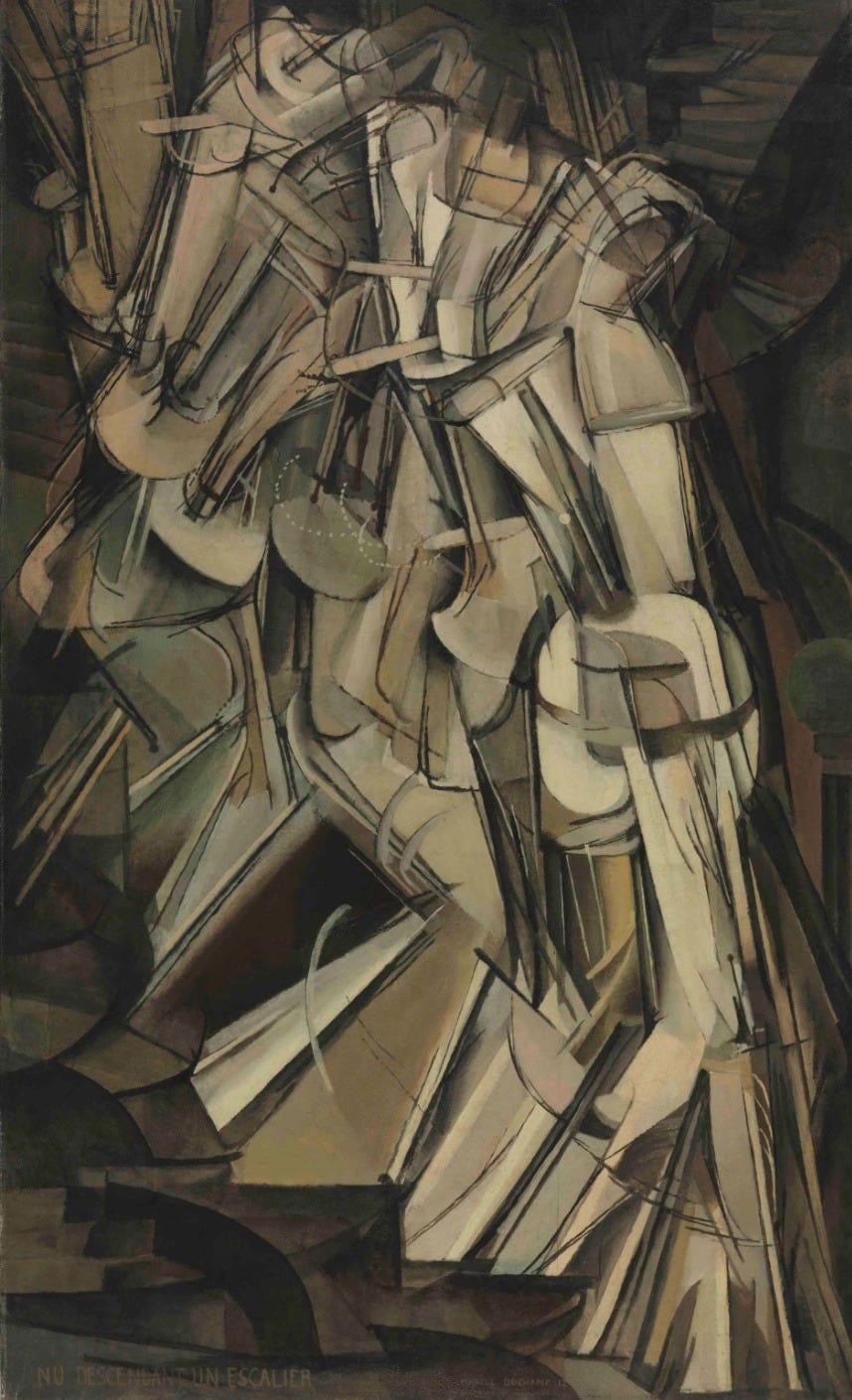
The overview article on MOMA’s website, written by Alexandra Drexelius, gives a good intro to Duchamp, but it starts after the paintings I’m talking about, with Nude Descending a Staircase (1912). That’s because Duchamp is no longer known for his paintings, except for the Nude. He’s known as the inventor of conceptual art. He should be known for painting, too, though. He painted in the newest-latest, most fashionable styles before World War One, until he found his own. He was not always a bold originator, and maybe never was. One of the most important notes in the galleries at MOMA is a quote from him saying that he didn’t want to keep painting because he was bored and didn’t want to repeat himself. The profundity of that one thing, not wanting to be bored, really hits me hard (as I approach the two months out from my 60th birthday).
This is the Nude Descending a Staircase:
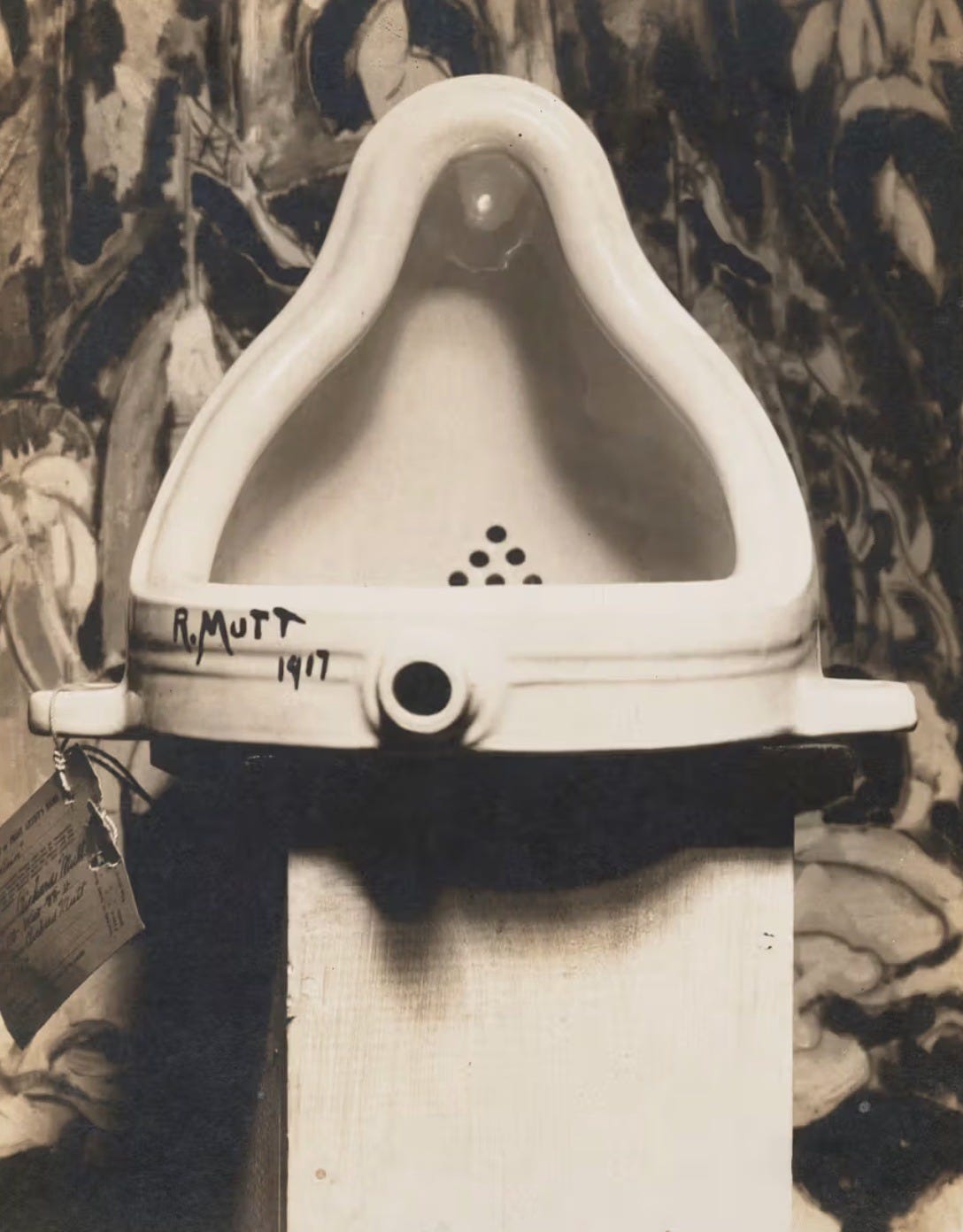
Drexelius’s number two is the famous urinal, Fountain (1917, The one in the museum is a replica of the one in this picture by Alfred Steiglitz. More on that in a bit):
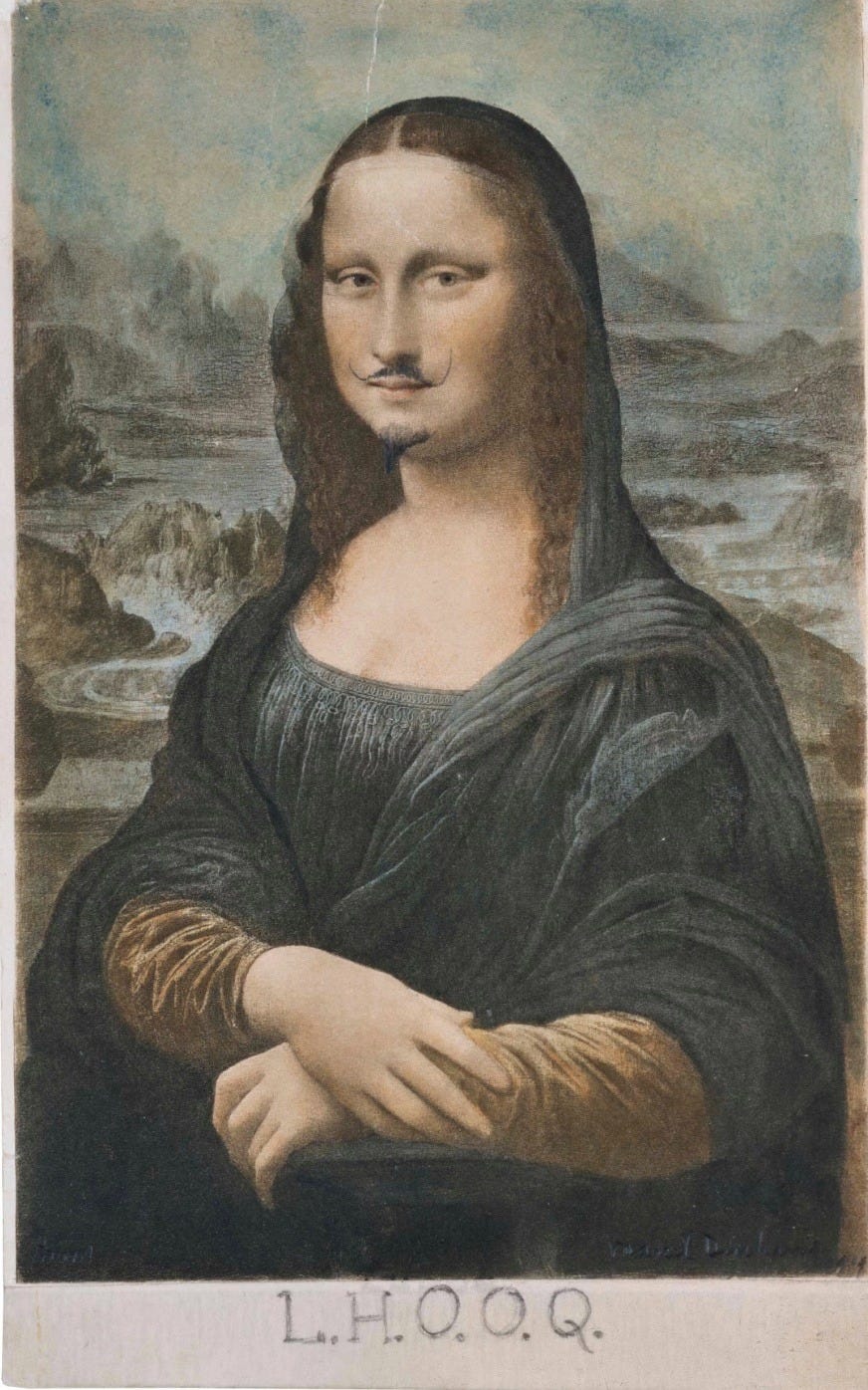
And at number three there is the defaced Mona Lisa post card he called L.H.O.O.Q. (1919):
The importance of these works, in order:
The Nude made a big splash at the U.S. Armory Show in 1914 in New York, the International Exhibition of Modern Art, where it became the object of much cartoon ridicule. Some of the cartoons are on display and they’re big fun.
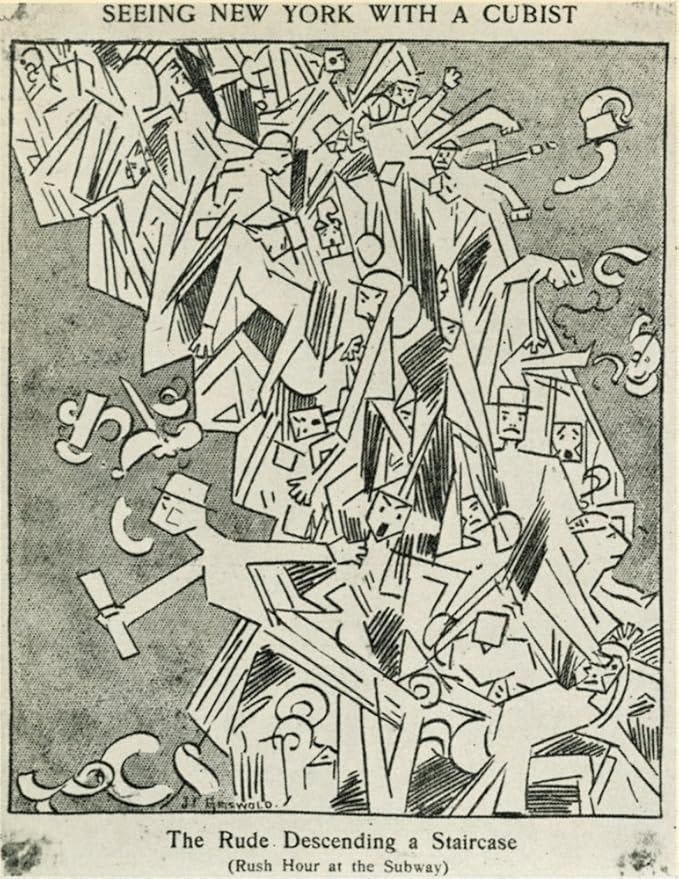
The Evening Sun 20 March 1913
The Nude (among other pieces) was the scandal of the show, showing Cubism to Americans but also the strange idea of having more than one moment in time depicted in a static image. One critic called it “an explosion in a shingle factory,” which nowadays sounds like praise. The ridicule of avant-garde art, and the way Duchamp was at among a group doing similar avant-garde things, and the way his work had the biggest impact, are all key elements of how this piece was received. The reception, for Dushamp, turned out to be everything. Without that, it’s just one of many, many Cubist works made before WWI.
The toilet bowl is supposed to be, it is now taken to be, the beginning of conceptual art. Duchamp was himself on the board of gatekeepers (Society for Independent Artists, or SIA) for an art show in New York, and said he was going to submit a painting to the show, Tulip Hysteria Co-ordinating, which probably never existed.
He bought himself this toilet, turned it on its side, and “signed” it Mutt, as above, and called it a “Readymade.” This idea of art derives in part from the “prêt-à-porter,” ready-to-wear, mass produced clothing that became established in the 19th century. Before that, clothes were tailored, and afterward we enter the world of S, M, L. It’s exactly upside-down from the idea of a work of art as a custom-tailored, hand-made, unique object with its own Aura, to use Walter Benjamin’s word from the essay, “Art in the Age of Mechanical Reproduction.” The committee rule had said anyone paying a fee could exhibit, but they didn’t count on this mocking move. They exhibited the toilet, following their own rule, but behind a screen, more or less acting in bad faith.
Later, Duschamp claimed that his intention all along was to move the “art” to the idea of art, away from the physical creation. Other people (Dada-ists) said the point was that the artist chose the work and re-purposed it (turning it) and in signing it, made it his. But those two explanations don’t go together. So was Dushamp CREATING CONCEPTUAL ART! or was he making fun of the way gatekeeping was being done in this specific show? The latter is a far smaller fish to fry. Mostly, it doesn’t matter whether Dushamp figured out the idea of conceptual art before or after he made a mockery of the SIA.
He gets the credit for inventing conceptual art anyway, but he shouldn’t, not alone. It’s quite possible that Duchamp backed into conceptual art. He “discovered” it after the fact because other people defended his mockery, taking it utterly seriously. Maybe it was just a joke, and then it was a revolution, not the other way around. Even as a joke it is a communal act, since a joke requires a joker, a butt of the joke, and a listener. There is a big irony in this process: the artist points to how silly it is to worship the Artist with a capital A, and in turn gets worshipped as the anti-worship guy.
The send-up of the Mona Lisa is a criticism of the aura of a work of art. The Mona Lisa was made famous completely arbitrarily, because it was stolen. Loads of Renaissance portraits are just as “good,” or realistic, or interesting. Go see the Raphael show currently at the Met. He’s got a few portraits that seem to me equal candidates for fetishization. The Mona Lisa is certainly a fetish object now. Try seeing it in the Louvre: all you will see is the crowd around it:
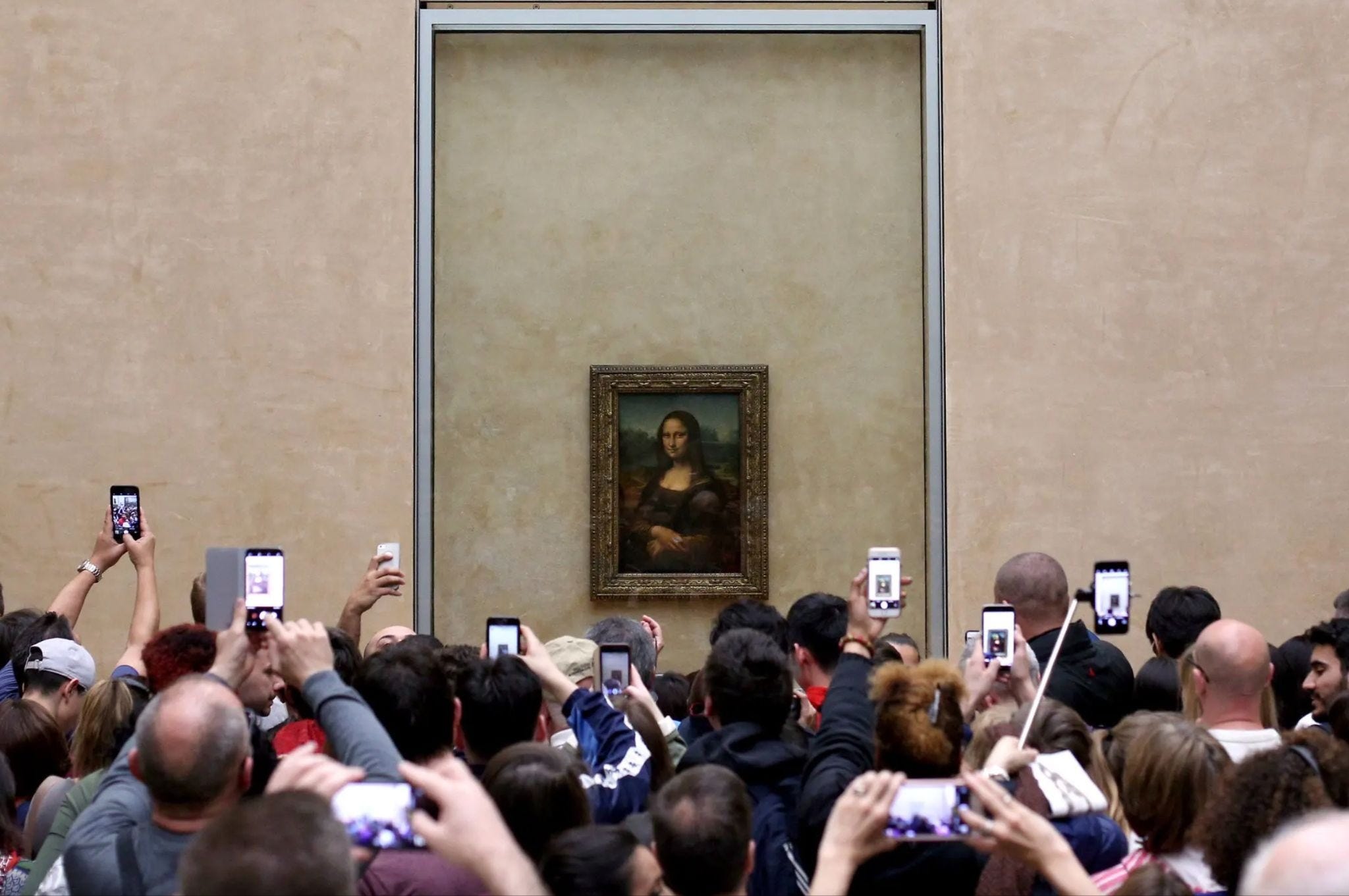
From NY Times article: photo by Pedro Fiuza/NurPhoto — Sipa, via Associated Press
The trickier piece of Duchamp mocking this situation is that the “aura” of a work of art is only present in the unique original (as per Benjamin’s idea of “aura”). Duchamp didn’t deface the OG daVinci painting. He defaced a post card, a commodified reproduction. So is that defacement a complaint about commodifying the great original, or the opposite, a complaint about how the original’s aura is itself a fetish, not earned/deserved by the painting? Another possibility is that it’s a lighthearted joke about how people make and sell postcards about anything popular nowadays. It’s just a pencil moustache and beard. No need to take it seriously. But there it is in the museum, listed as one of Dushamp’s Top Nine.
Dushamp lost the battle against Aura. What’s the value of the toilet bowl in the MOMA show, even if it’s not the original one he entered into the art show, but a later one he blessed with his signature, again? Why did he do that, anyway? Why not be pleased that the original was lost? Dushamp was just a human being and was not above taking advantage of his own aura as an Artist with a capital A.
This review leads me back to Duchamp’s pre-Nude, pre-cubist paintings in the MOMA show, which were, as I said, a revelation for me. This feeling happened because the first room of paintings show Duchamp cycling through many of the avant-garde styles available between 1905 and 1911.
He paints like Matisse at times:
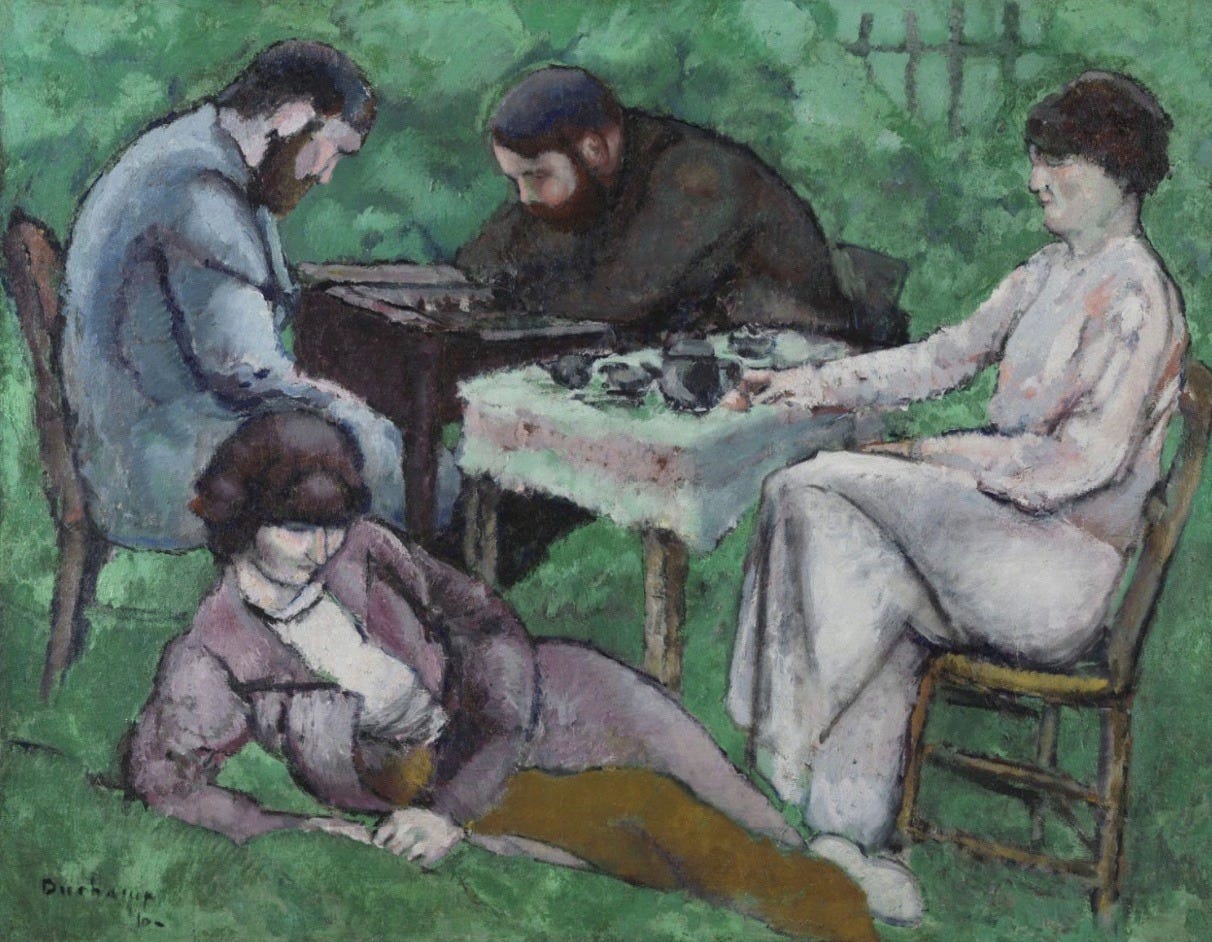
The Chess Game (1910)
And at times like Gauguin (A friend I was with pointed out that this is like a Gauguin. Once you are told this, it’s impossible to unsee the resemblance.):
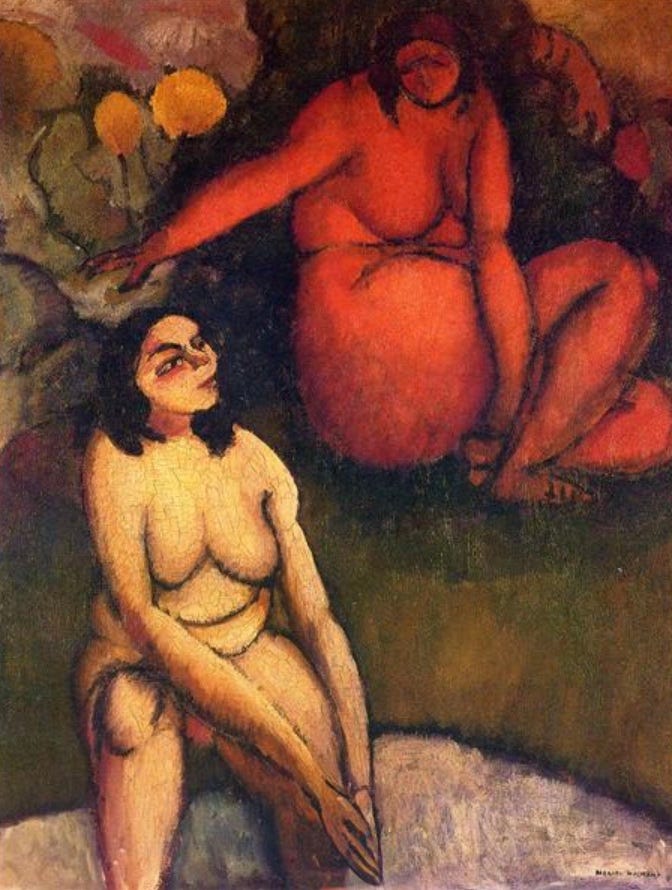
Baptism (1911)
Or like a Fauvist/Picasso Blue Period painter:
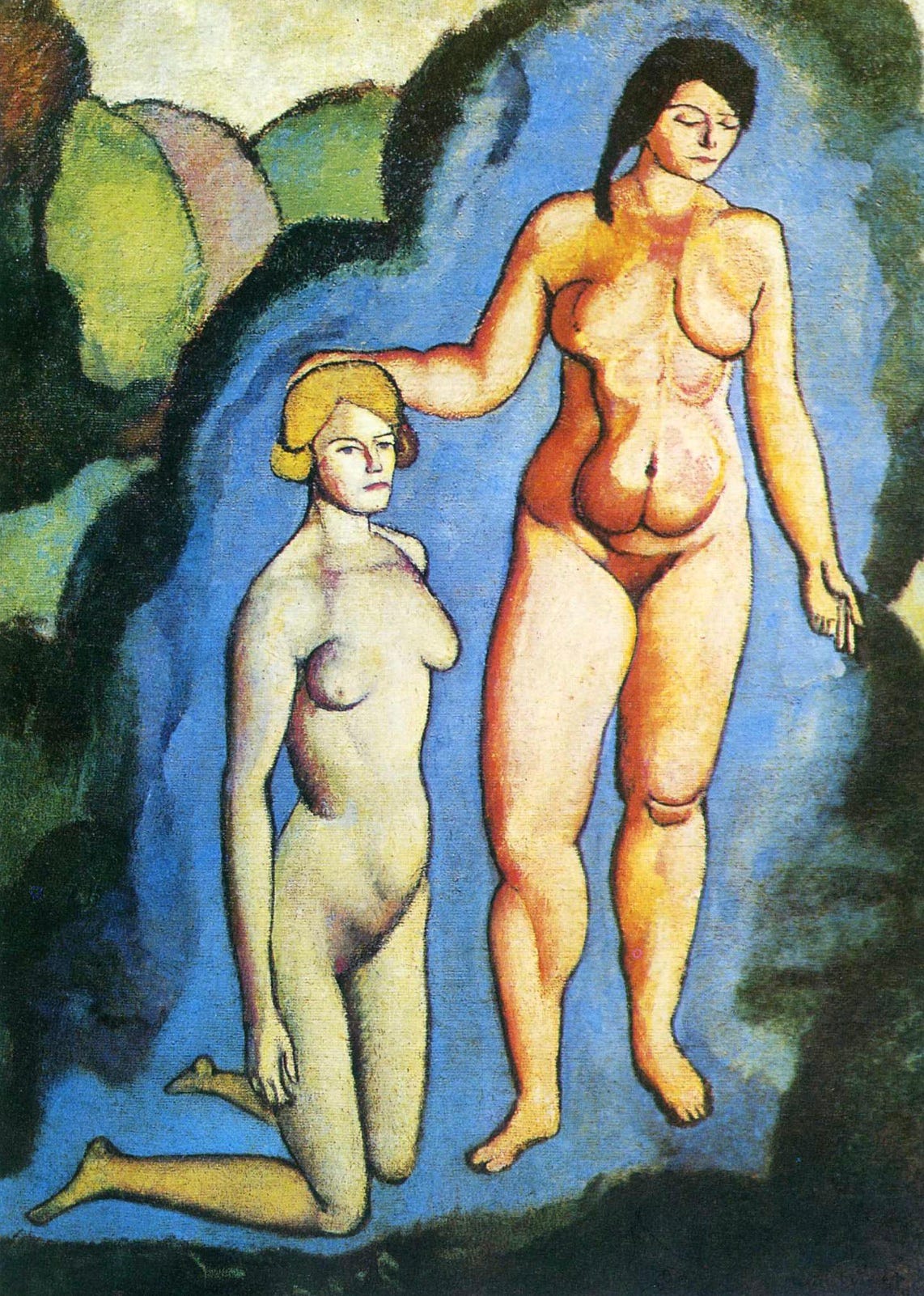
The Bush (1911)
Early in his painting career, before he “discovered” the readymade concept (or it discovered him), Duchamp was figuring himself out as an artist in a community of artists, all of whom were talking about reinventing art after Impressionism and Cezanne had shown them the first steps. You could accuse him of being a fashionable painter, but the same accusation would then have to be made about all of these people, men and women talking together, thinking communally about what they were doing.
Because of Duchamp’s genius, or regardless of his intentions, what he did matters now. It is impossible to imagine Tracey Emin’s My Bed (1998) existing without Duchamp entering his toilet in that show. Emin’s piece is interesting and provocative, and also narcissistic. You want us to look at your bed? You didn’t make anything? Just because you’re an Artist, you get to show us your junk or what you bought from a plumbing supply shop? The narcissism of the toilet is hard to beat. Either the Dada-ists were right, and merely by choosing and turning and signing a toilet, Duchamp made “art,” (an incredibly narcissistic idea) or Duchamp was already severing the making of a work from the maker when he entered his joke piece, but either way, the conceptual act points to the arbitrariness of pointing to any given thing and saying it’s art. And who gets to do that, after all? Not you or me. Only the Artist does.
I, too, thought that the early paintings and drawings were the revelation of this show. That Duchamp was so skilled with a pen and paper was interesting to me. The paintings struck me as of a piece with his time in a fairly dull way. As if Gaugin had stayed home. Another thing that was interesting was that the readymades that were original still held power for me. Appolinaire Paints was one example, but With Hidden Noise is my favorite - the idea that there is something hidden in a work of art that even the artist cannot identify feels powerful to me.
On the other hand, the other reproductions of the other readymades - the urinal, the bottle racks - seemed antithetical to Duchamp's original sense of humor and spontaneity. Apparently it is not only the artist who gets to turn ordinary things around and say they are now art - the curator and the art dealer can do it to.