Erin Jane Nelson's Photography Practice at the Whitney Biennial 2026

I’ve heard that there are people upset with the Whitney for not being political enough in this year’s Biennial. I have two reactions to that criticism, having just seen the show twice.
One, sure it’s political, if only because of the expanded definition of “America” that the curators are using: “Alongside artists from across the country, the exhibition features works by artists from places marked by the broad reach of US power, ranging from Afghanistan to Vietnam.” (This sentence is in the “overview.”) Aziz Hazara, born in Afghanistan and living in Berlin, is included in the show. I don’t think this person is American, but I accept the pro-globalist reaction against MAGA and international right-wing anti-immigrant politics.
If this is a mistake, I like it. My parents fled the Nazis in 1939. I’m never going to be anti-immigrant. Instead of saying “we can’t” accept whoever wants to come, we should remember our history, when in the late 19th and early 20th centuries, immigrants flooded the U.S. and Made America Great. Before that flood, America had no pizza, and no Jewish Broadway or Hollywood. Let’s devote a Marshall Plan-sized budget to integrating another such flood. In the future, those countries that survive will have people (India, Nigeria) and those that don’t will be the xenophobes (Japan).
The artist I’m going to discuss, Erin Jane Nelson, said in a talk that she’s only in the American Southwest landscape she is photographing because she is taking care of her immigrant grandfather, who lives there.
Two, there is a fundamental argument about what a museum of art is supposed to do. There will always be people who think aesthetic concerns are frivolous or worse, distractions from political and power struggles. The second time I went, I was accompanied by an artist friend who said that showing people a new way to see is always a radical act. As Percy Shelley wrote in “A Defense of Poetry,” (1819), “Poets are the unacknowledged legislators of the world” because they imagine what could be, and don’t just describe what is.
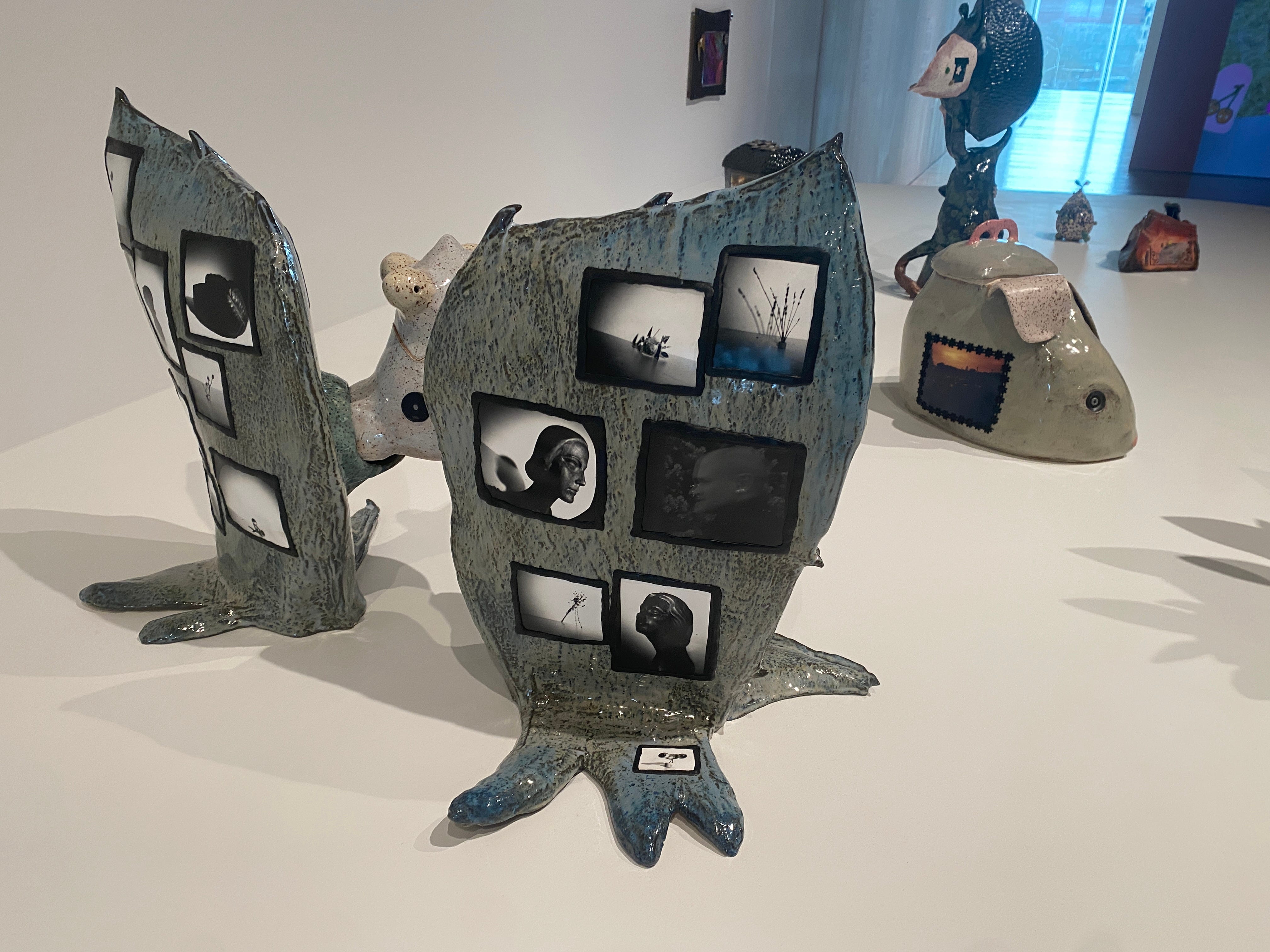
Erin Jane Nelson’s work was my favorite. This is their description: “Erin Jane Nelson’s ceramic sculptures are also functional pinhole cameras, which she used to create the nearby photographs. Working in the desert of northern New Mexico, she rests the cameras on the ground so that they remain still through the long exposure time they require. Rather than picturing the region’s famously dramatic vistas, Nelson creates intimate views of the underlying ecological systems.” Her website doesn’t say much but links to this, and this, where there are good examples of her work, though not all the same as the work now in NYC.
At a talk I attended, she spoke about how the landscape she photographed in this project has been extensively photographed before by artists such as Dorothea Lange , Edward Weston, Ansel Adams, Carleton Watkins and Alma Lavenson. This is the American West, usually shown in desert landscapes, dry and forbidding, but Nelson wanted to show the lush greenery that she found.
Here are some of the ceramic pinhole cameras she made:
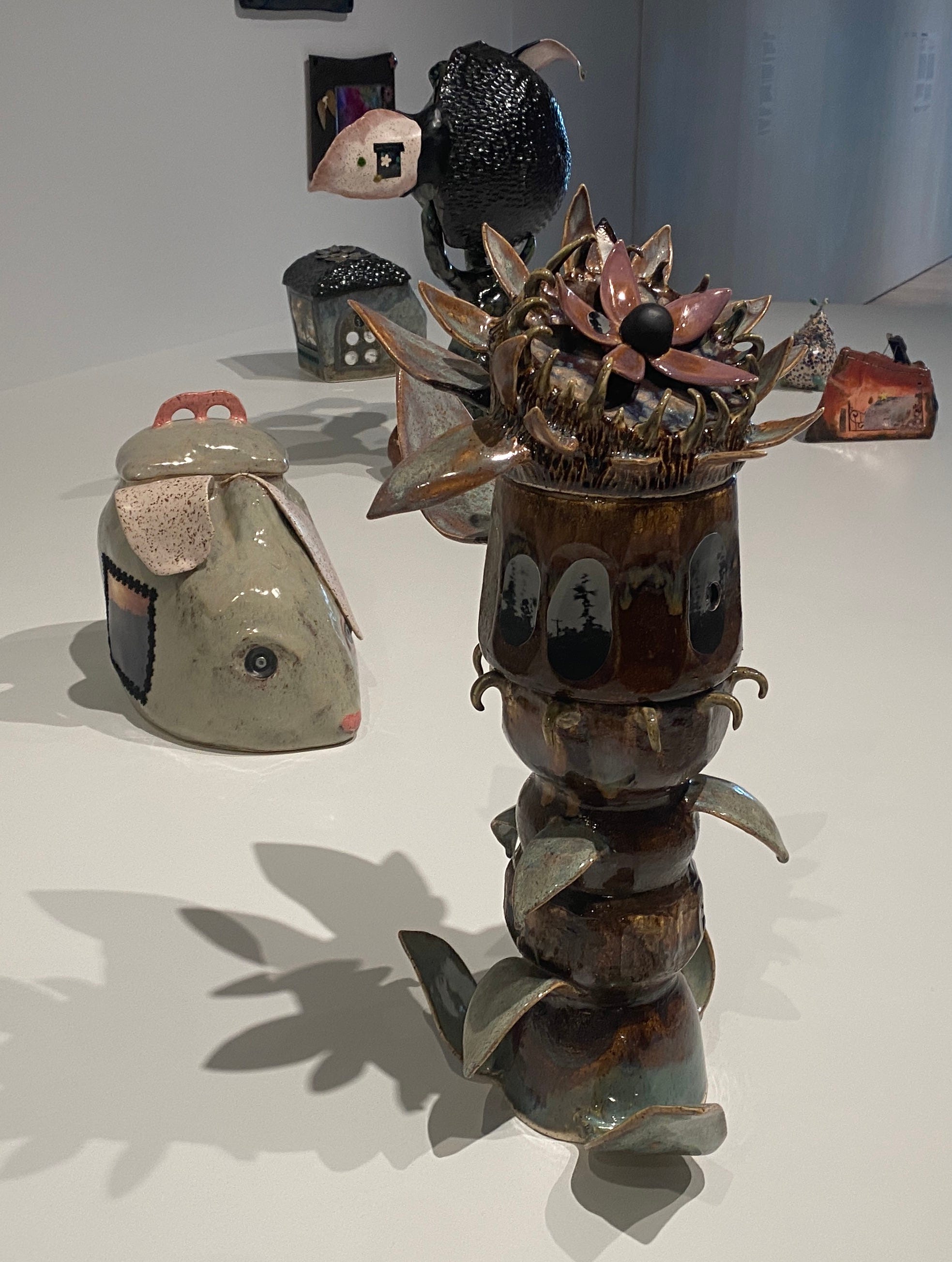
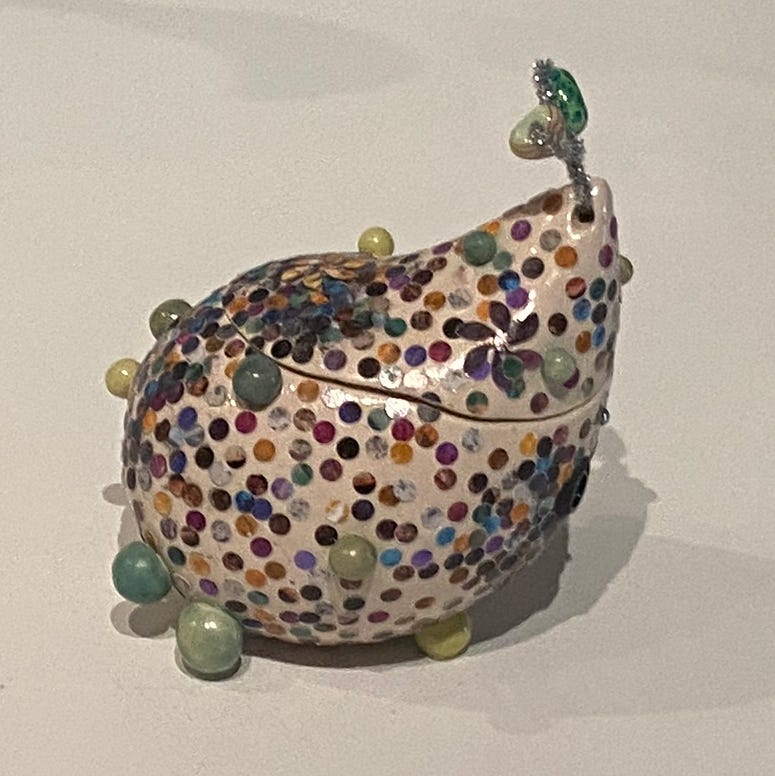
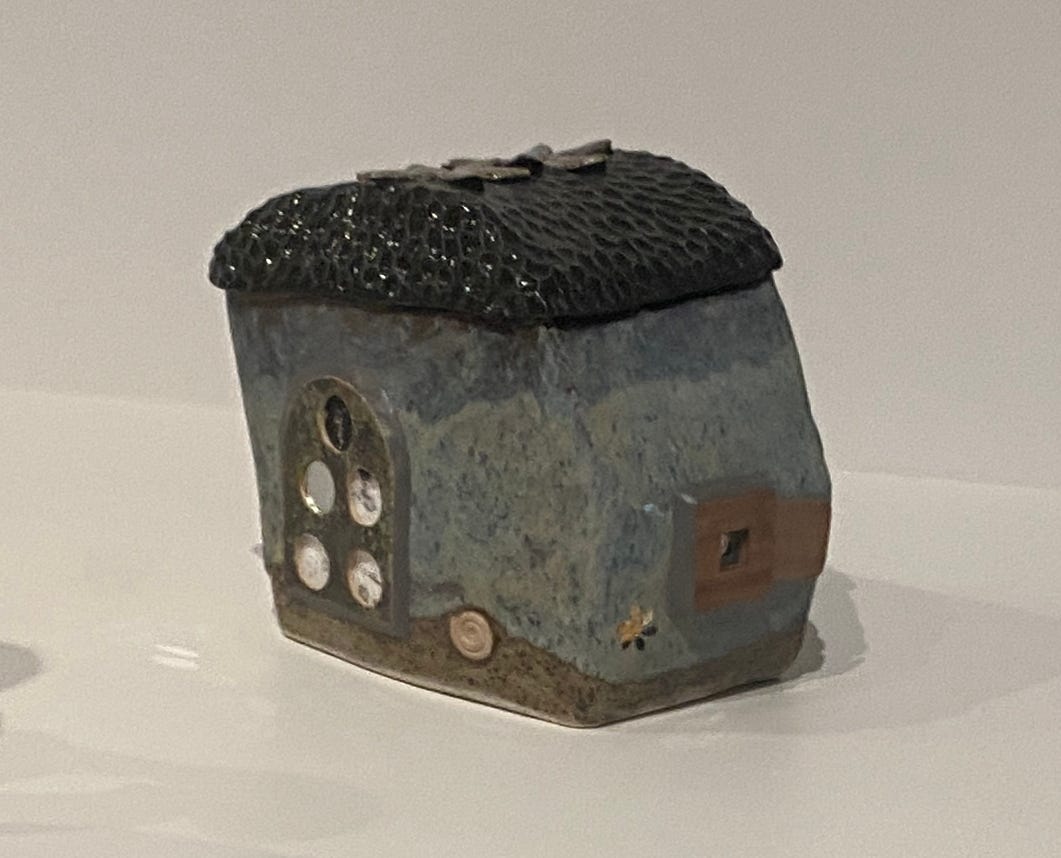
The one below features a photograph of the artist mounting a manufactured camera onto a tripod. One of the creature’s eyes is the pinhole.
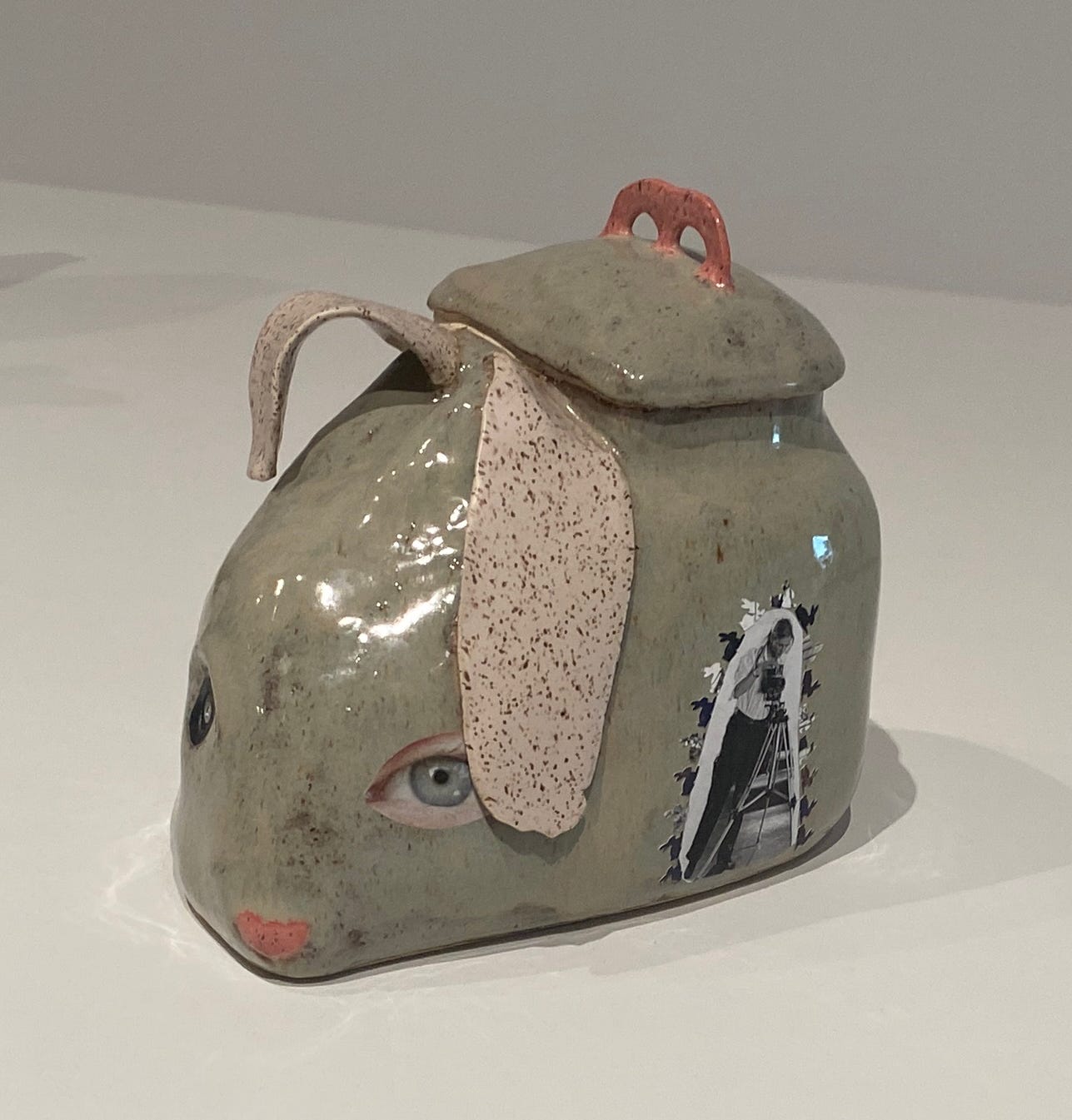
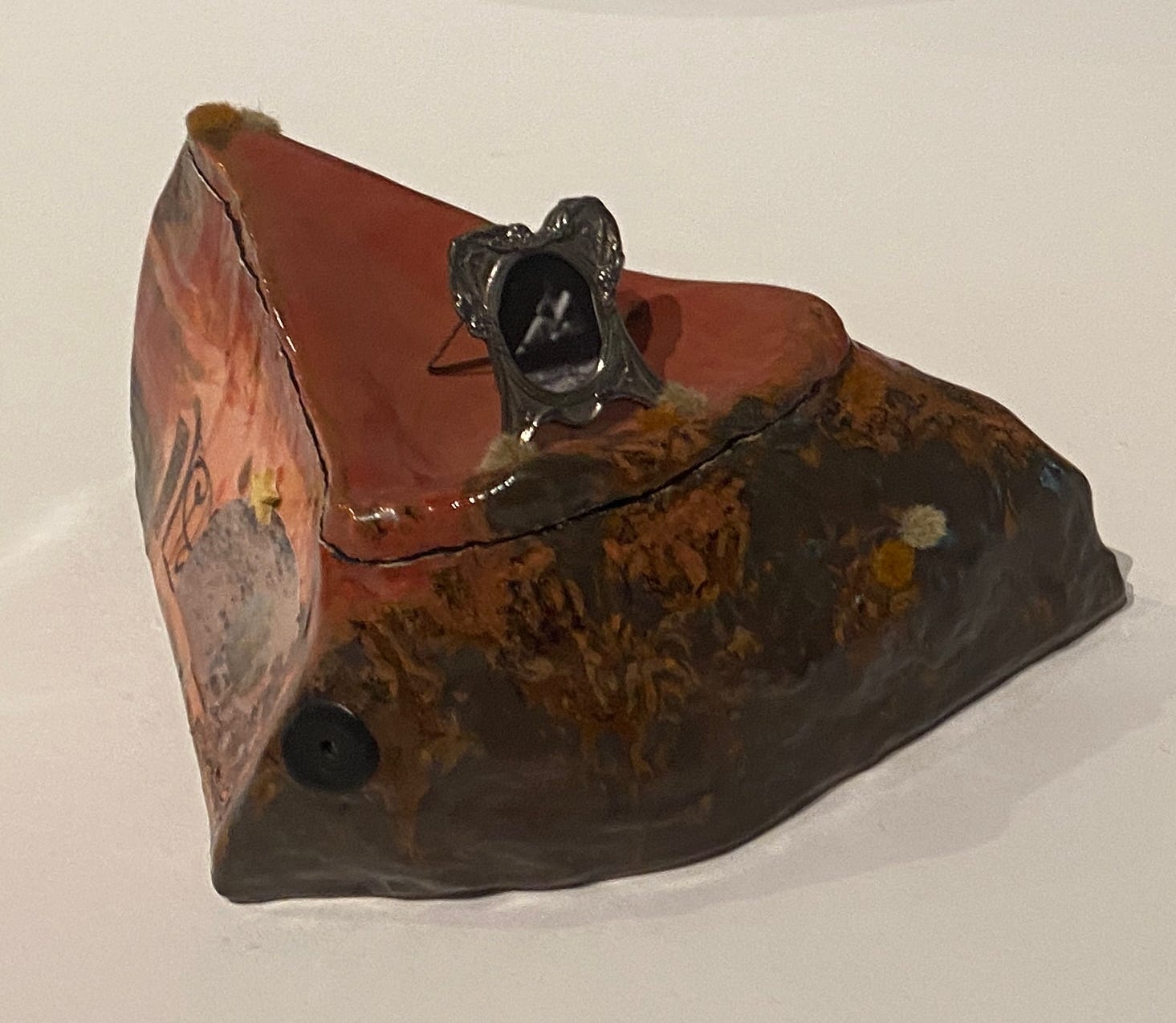
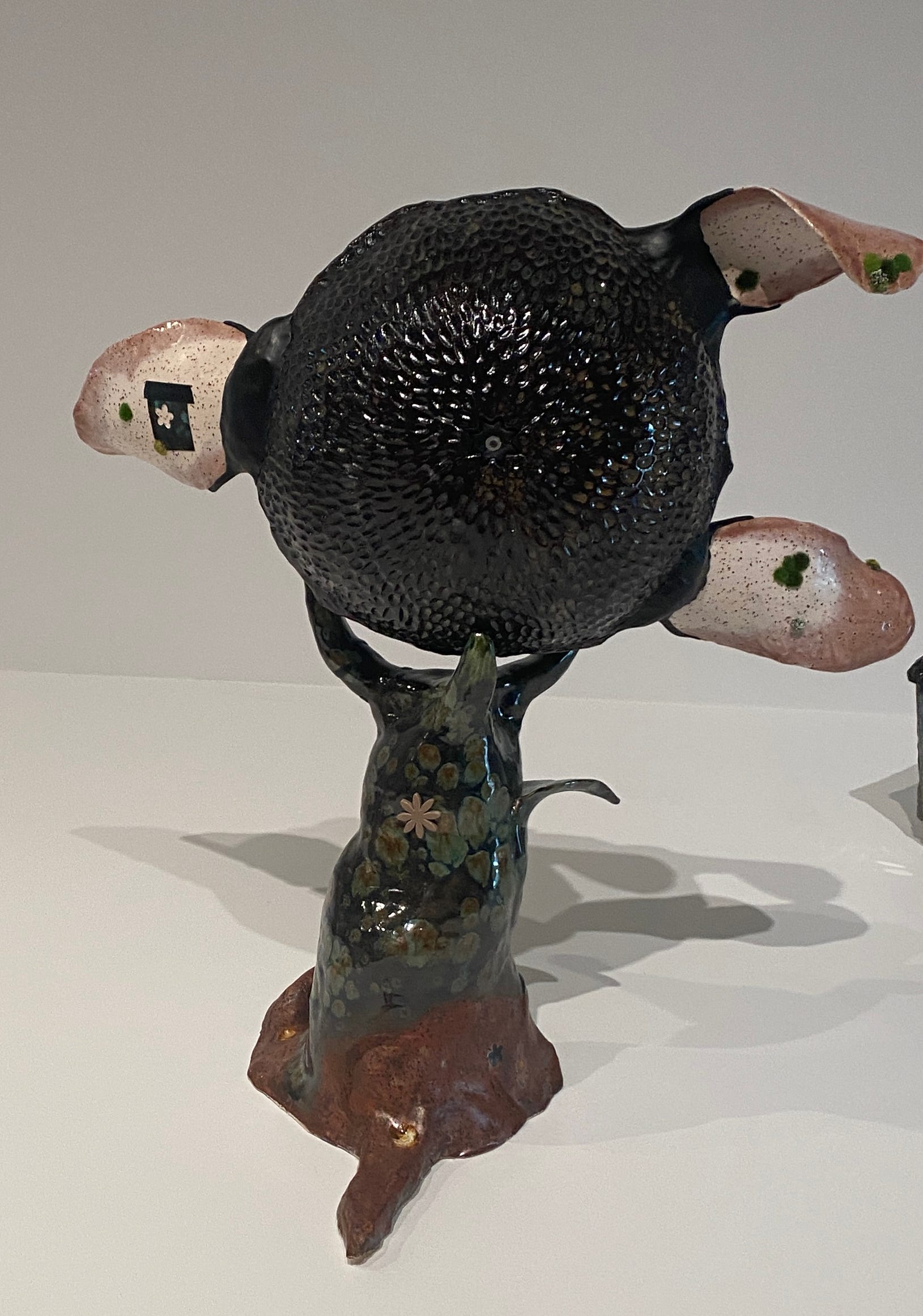
A “camera” is, literally, a “chamber” into which the maker puts a place for film or a digital receptor. It’s dark inside. There’s some kind of way of letting in a little light for a set time. That’s it. In the talk, she said she puts 4x5 film in the ceramic camera and opens the pinhole shutter. I can’t see from looking at the cameras how she puts the film in, though I see they have removable covers. Maybe inside a light-proof bag called a changing bag?
This is a cumbersome process. First, make the camera! Each of her shots is going to take a while with the pinhole non-lens opening. It is the opposite of the casualness of contemporary photography. People seeing the show, or any museum show, take phone pics of the art, or each other, or themselves, and then pics of the wall explanations, too because there is nearly a zero cost to taking a picture. For the most part, they do not compose very carefully, and they do not and mostly cannot set the aperture or shutter speed. No tripods are involved. Nothing is developed. No previsualization skills are required, as the screen tells you what is in the shot and exactly what will “come out” in the picture.
I am reminded of the issue of difficulty in art-making. It takes a long time to learn to push oil paint, to control the colors and the textures. The difficulty pays off because the infinite sensitivity of the medium is there for the artist ones they learn. Learning piano or violin takes an entire childhood. The violin in particular gives a sense of the payoff for learning something incredibly difficult. The wide range of tones possible in a violin is intimately connected to the difficulty of controlling what tones you make.
Photography has always had to apologize for ease of use. You’re not drawing anything (though knowing how to draw sure helps). People need to learn about composition to understand what value a photographer/artist adds over and above someone taking snaps. Look at how many people mastered even the completely manual cameras of the past, now considered hopelessly clunky. Millions!
And yet, if a photographer becomes even mildly more serious, she learns not only to previsualize what a shot on film will look like depending on the way she lets light hit that film. She also learns how to print for effect in the darkroom. That’s not to mention the process of picking which images matter.
I remember my dad composing his Minolta camera on us (mom, brother, me), then setting the shutter speed and the aperture opening along with the built-in light meter while we complained that it was taking too long. He shot on slide film, which was more difficult to use because more sensitive, and because there was no print, usually, so no forgiving process of correcting for a shot not exposed just right. Yet he did make maybe a thousand really good slides.
I’ve used large-format cameras. A highly sophisticated, modern 4x5 camera is still slow and hard to use. It needs to be on a tripod. Composing is done on ground glass, upside-down and backwards, with no film in the camera. After that, you put the film back in and take out the slide, then release the shutter, put the slide back in, remove the film back, and put in another one, or recompose.
Nelson cannot compose on ground glass. She’s doing point-and-shoot, but she can have only a general sense of what she’s getting. This is previsualization to the max. I imagine that each camera she makes has its own quirks to learn, and maybe some are duds. But her work does NOT look like phone pics. Maybe that’s what artists have to do now: to separate themselves from the infinity or images, or what David Foster Wallace called “total noise,” they have to move into extraordinary processes.
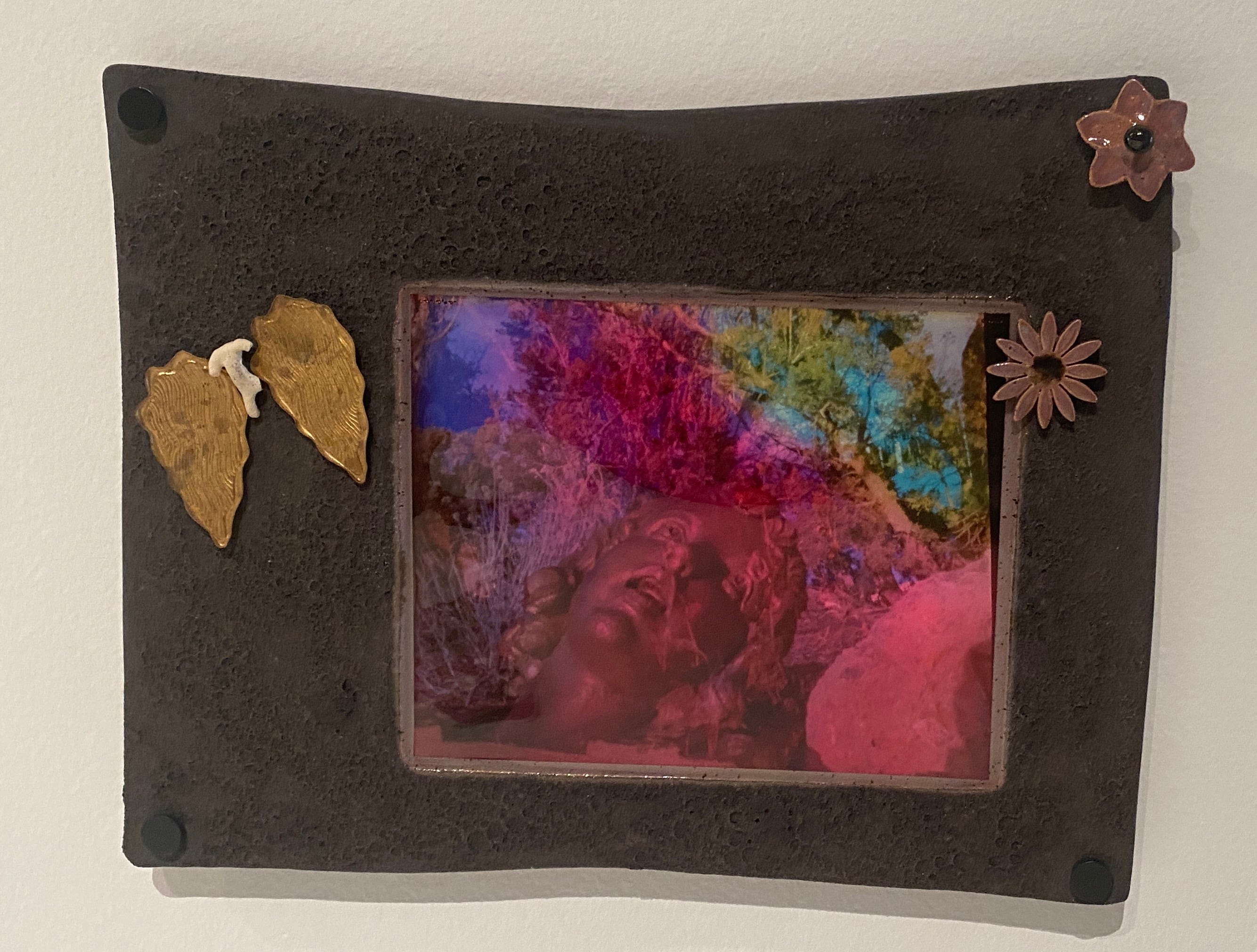
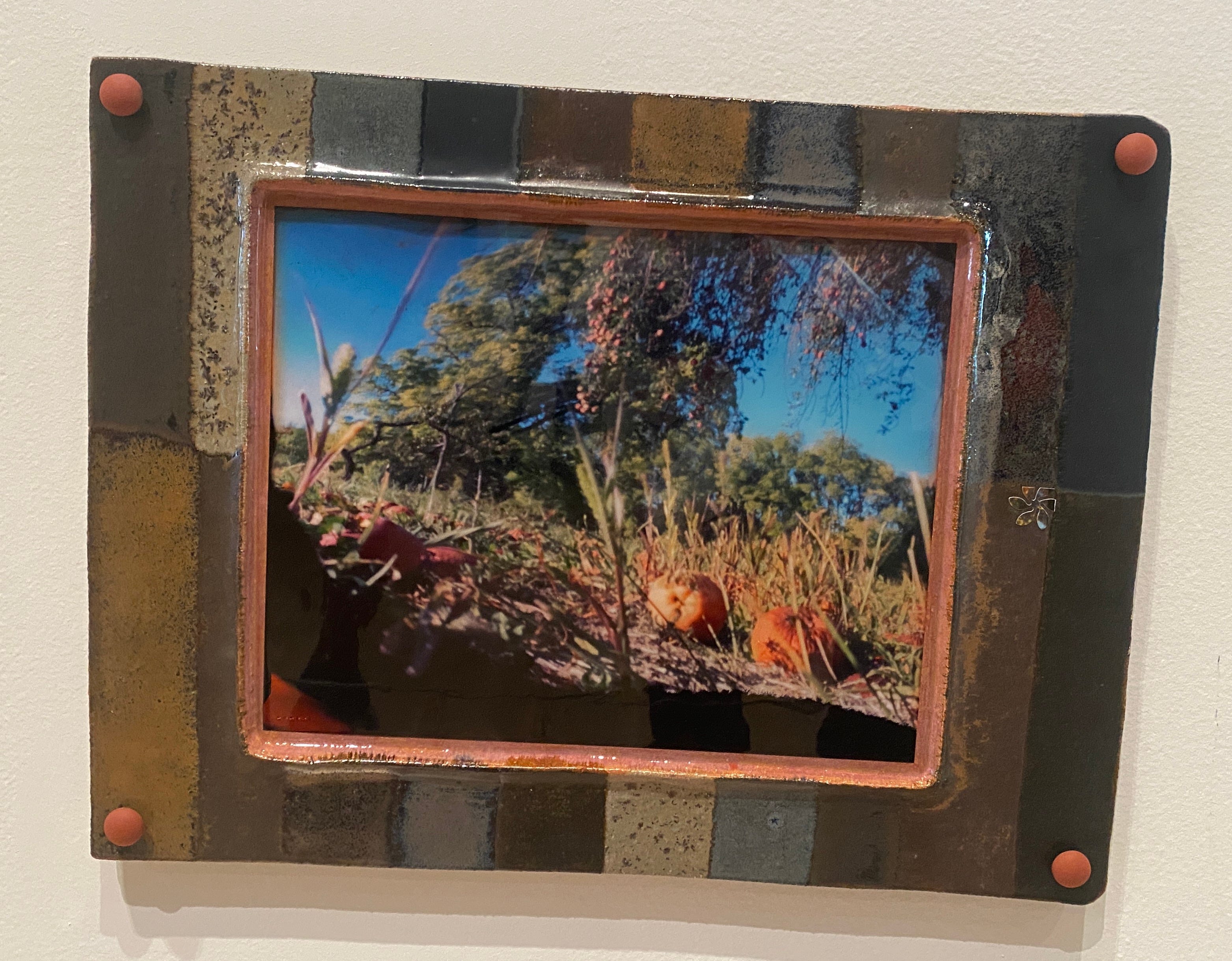
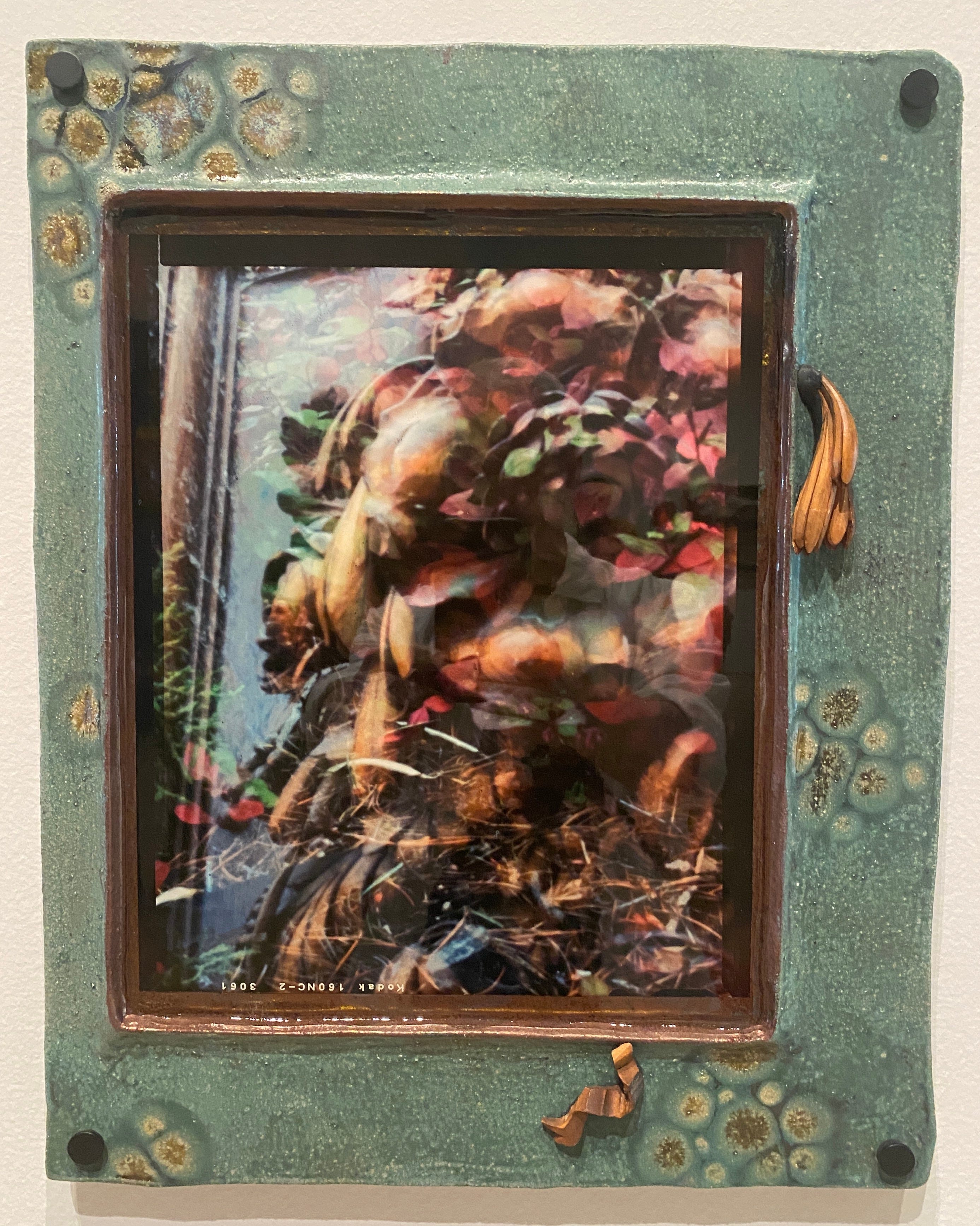
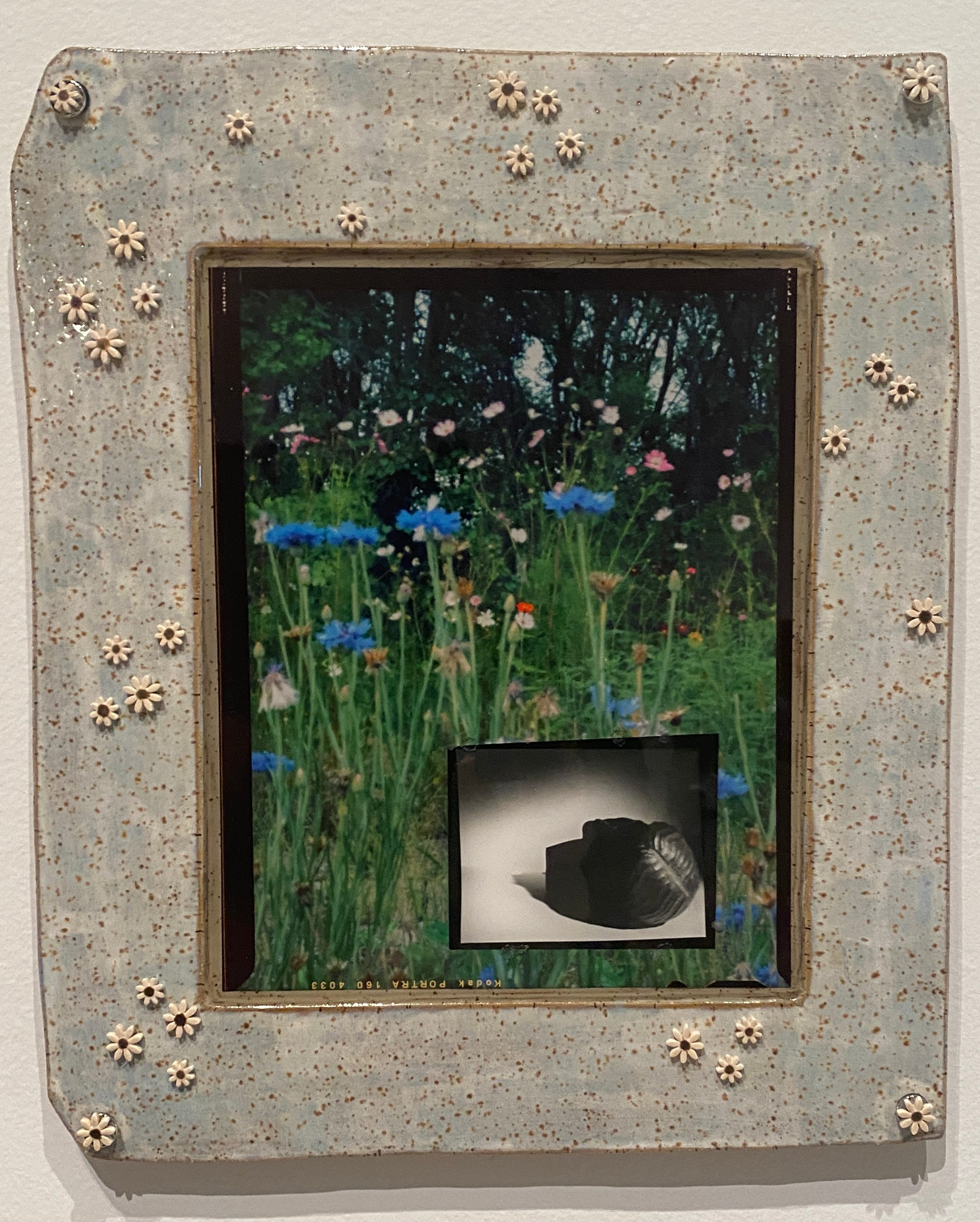
And here below are some of the images she made using those cameras. The frames are her ceramic work as well. They show some of the hallmarks of pinhole photography, particularly the color stains that result from glare inside the camera. The colors in the second one show why this is all worth doing, just from the point of view of images made, quite apart from the art of the cameras themselves. The whole point for me is that I’ve never seen anything like this body of work. I do not know if that is a political thing but I am satisfied.
How I do love a pinhole camera. Gotta get over there while it's up. Thanks!