Art of the Future
...in the Museo Tamayo Arte Contemporáneo in Mexico City

When in Mexico City, see Latin American art.
The Museo Tamayo Arte Contemporáneo is one of several in the same park in Mexico City along with the Modern Art museum and the The National Museum of Anthropology, which wikipedia says is “is the largest and most visited museum in Mexico.” (The Anthro Museum is worth at least two days visiting and I hope to go back there, but I was in CDMX for Art Week and wanted to see as much art as possible.)
Mainly, we saw the “Futuros Arcaicos” show (“Archaic Futures”), which is a mix of sci-fi, abstract, and futuristic (but not “Italian Futurist”) paintings and sculpture. Some of the art made me think, “future,” and some didn’t. What makes you think of a futuristic feeling is elusive. I am still formed by space operas, the Star Trek / Star Wars industrial complex. Perhaps even more deeply embedded than that is the cheesy futurismo of earlier sci-fi Hollywood, such as is parodied but partaken of in Barbarella with Jane Fonda (1968):
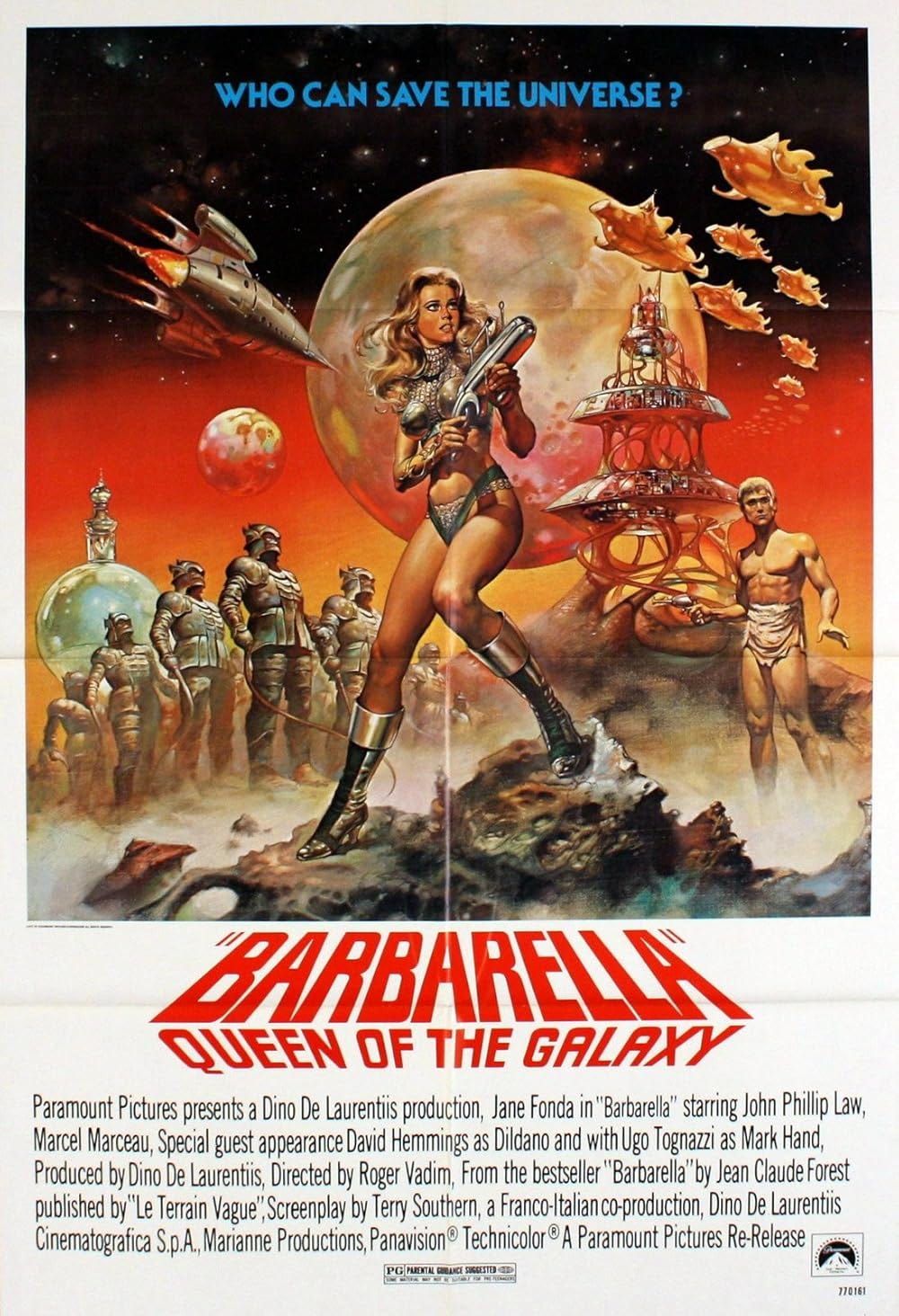
This is a complex image because it is 1) the parody is of the sci-fi movies of the preceding decades and, more importantly for me, 2) it’s more about the moment in which it is made than about the actual future. The film’s “story,” such as it is, is about the fear of planetary destruction, a focus on (big, throbbing) rockets, the male fear of never having fun sex (again?), the male desire voyeuristically to witness female sexual pleasure, cool 60s boots, and big 60s hair. Yes, all important, maybe universal, but what about the coming Socialist World Order? Why wouldn’t we all already have realized that sharing is caring? I don’t remember if I believed in any kind of Positivist vision of History in which its arc bends toward justice. Maybe I did in 1990. Not any more. Why would Latin America have become neo-colonialist while the United States became a super-power? History seems random and contingent, and thus, so does the future.
The first picture we saw in the show is Arcangelo Ianelli, “Breaking of Forms,” 1976.
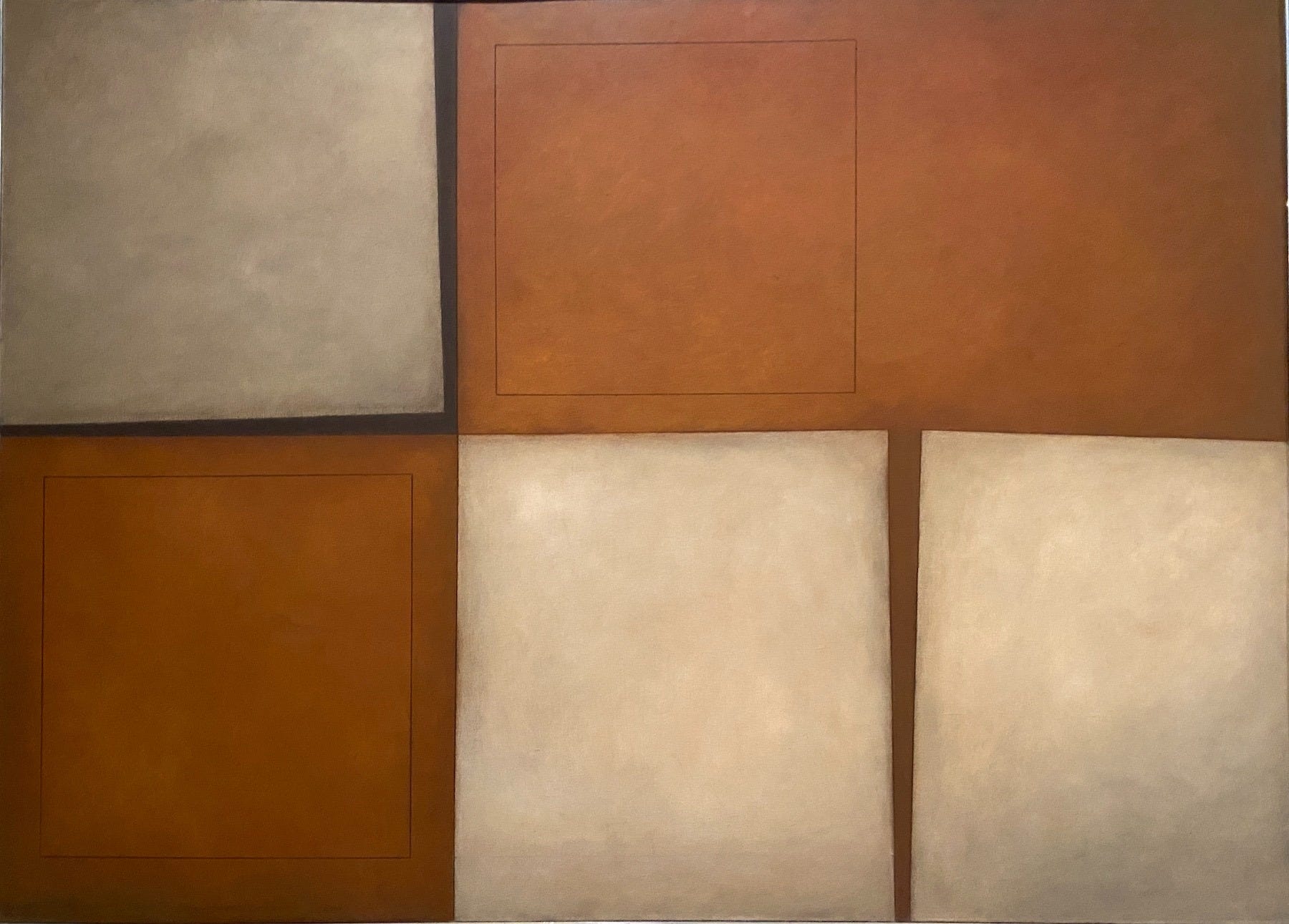
This Brazilian artist moved into abstraction in the 1970s, using rhetoric like “freeing” himself from figurative work. In that sense it might’ve felt as if he was moving into the future. That feeling is something we have to reconstruct for ourselves now. The “Breaking” part of this image, in the way the squares float away from one another, remains provocative if we think about how it isn’t exactly minimal any more. It’s as if the modernist flat painting is falling apart as much as reaching its apotheosis in 60s minimalism. In any case, this kind of minimalism seems entirely of its moment to me, not “future” but 1960s.
The case that I’m making, that the art is more of its time than anything else, doesn’t always hold up. This image by Joan Miro called “Painting” from 1927 strikes me as more odd and thus more futuristic than the one above:
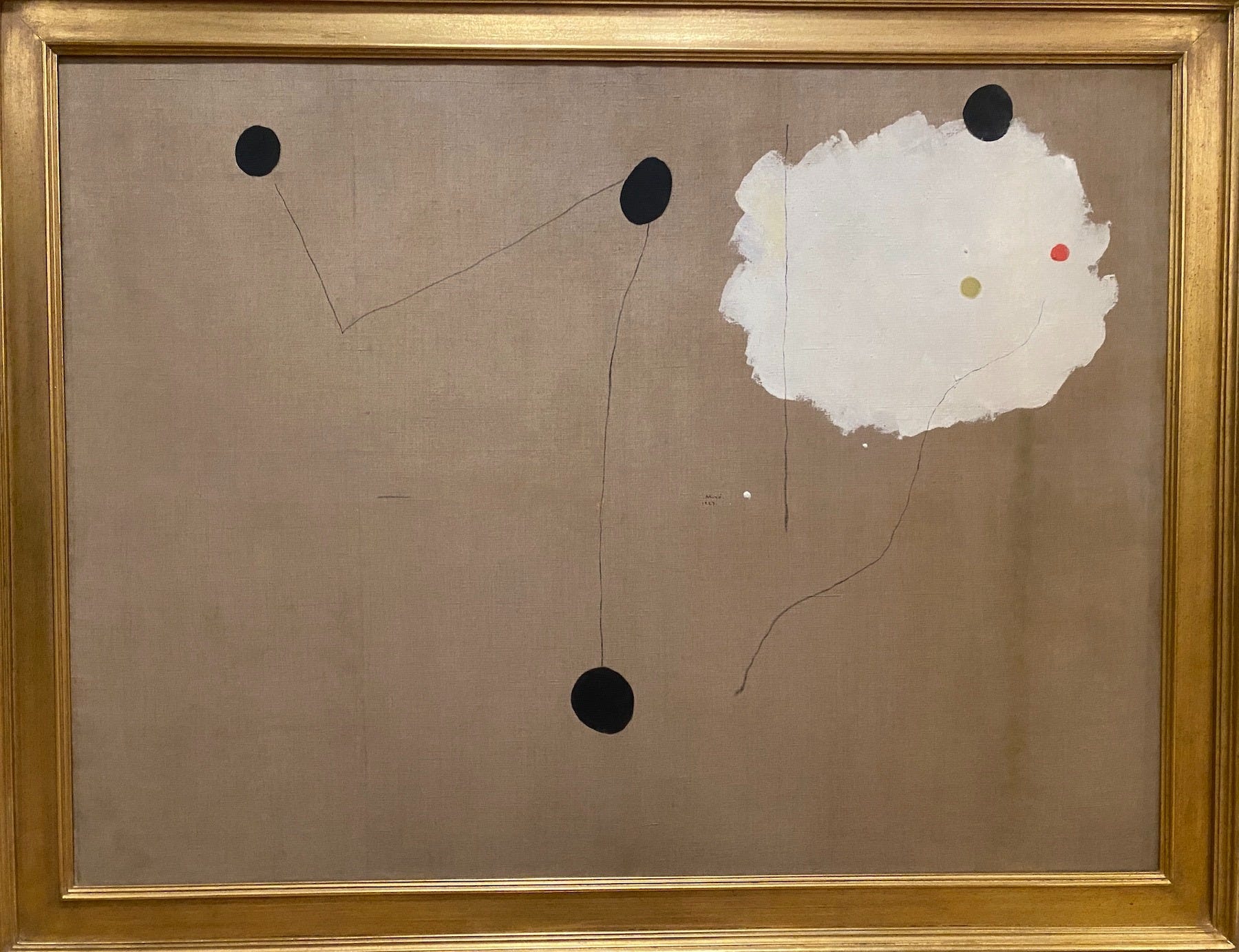
It’s like a lot of other images that Miro was doing at the time except that it has no landscape features, unlike “Landscape with a Rooster,” also from 1927 (not in the show I saw):
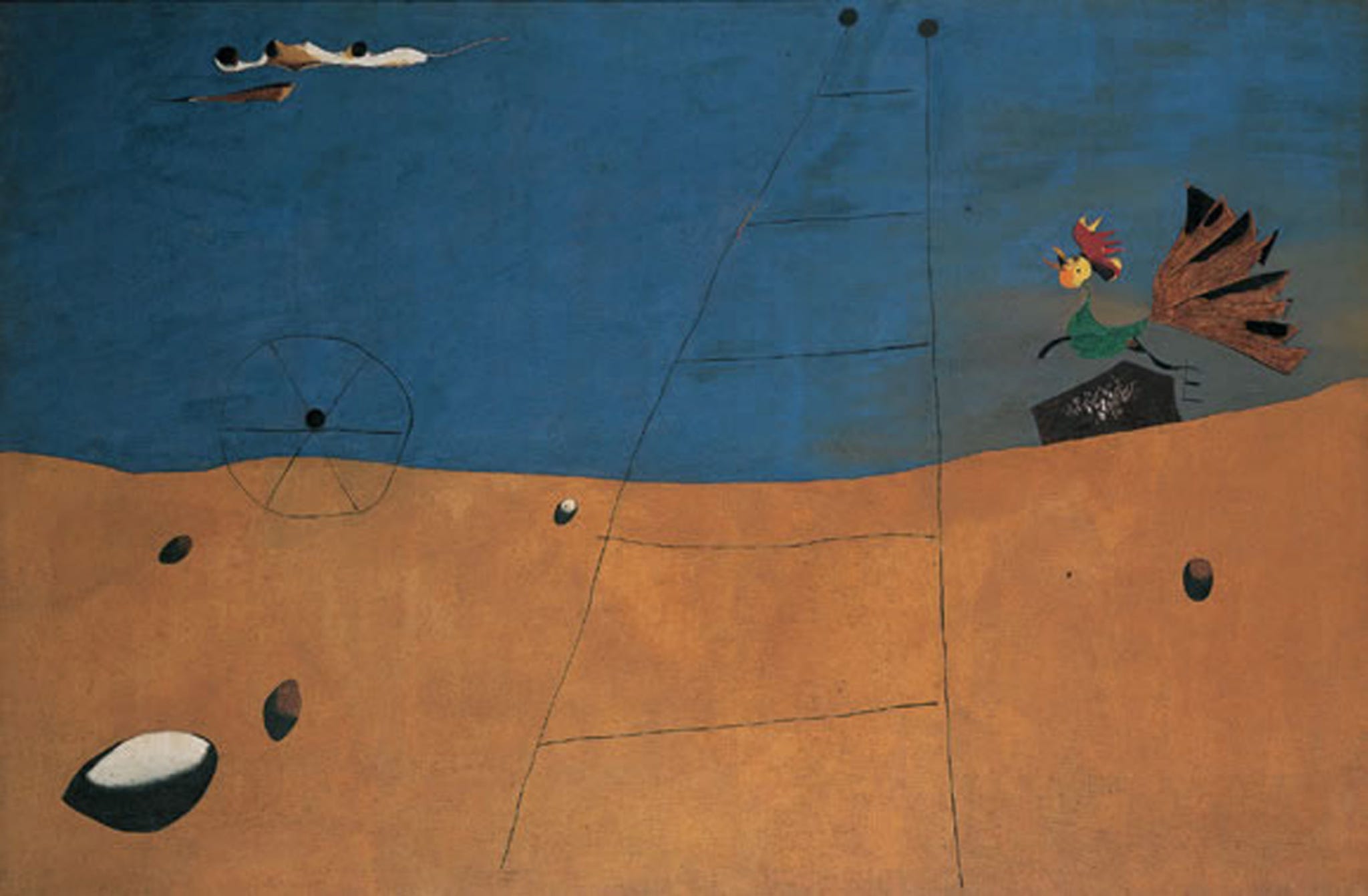
The “Painting” has no reference points. I can imagine it as a code from outer space, a language of alien beings. As opposed to the “Landscape,” which looks surreal in a child-like way.
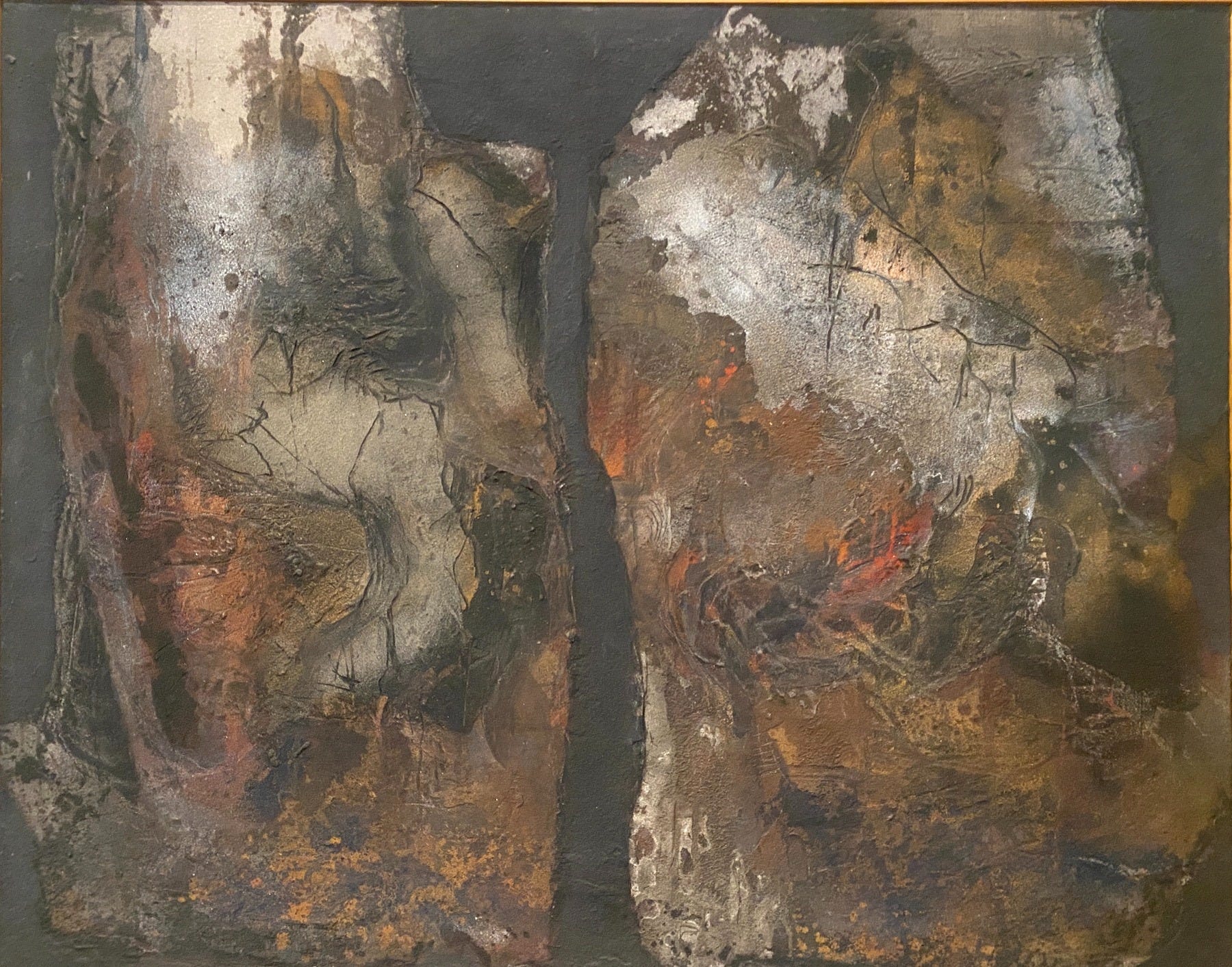
Mexican artist Irma Palacios’s, “Mineral Landscape,” 1984, is, I think, still in the Spanish Informalist style, which is to say, like Abstract Expressionism, using the random elements of the medium, and not geometric like Ianelli’s minimalism above. I can see the idea that in the future of 1984, people thought art will look this way, but since it didn’t always, the futuristic nature of the painting is once again elusive. Having said that, I will add that I found this painting explosive and read into it a depiction of an apocalyptic event, as if the black central piece were a tornado.
In Mexican artist Alvar Carrillo Gil’s, “Before the War,” 1953, the painter displaces the figures of war into stylized, pointy forms and arranges them into a pattern:
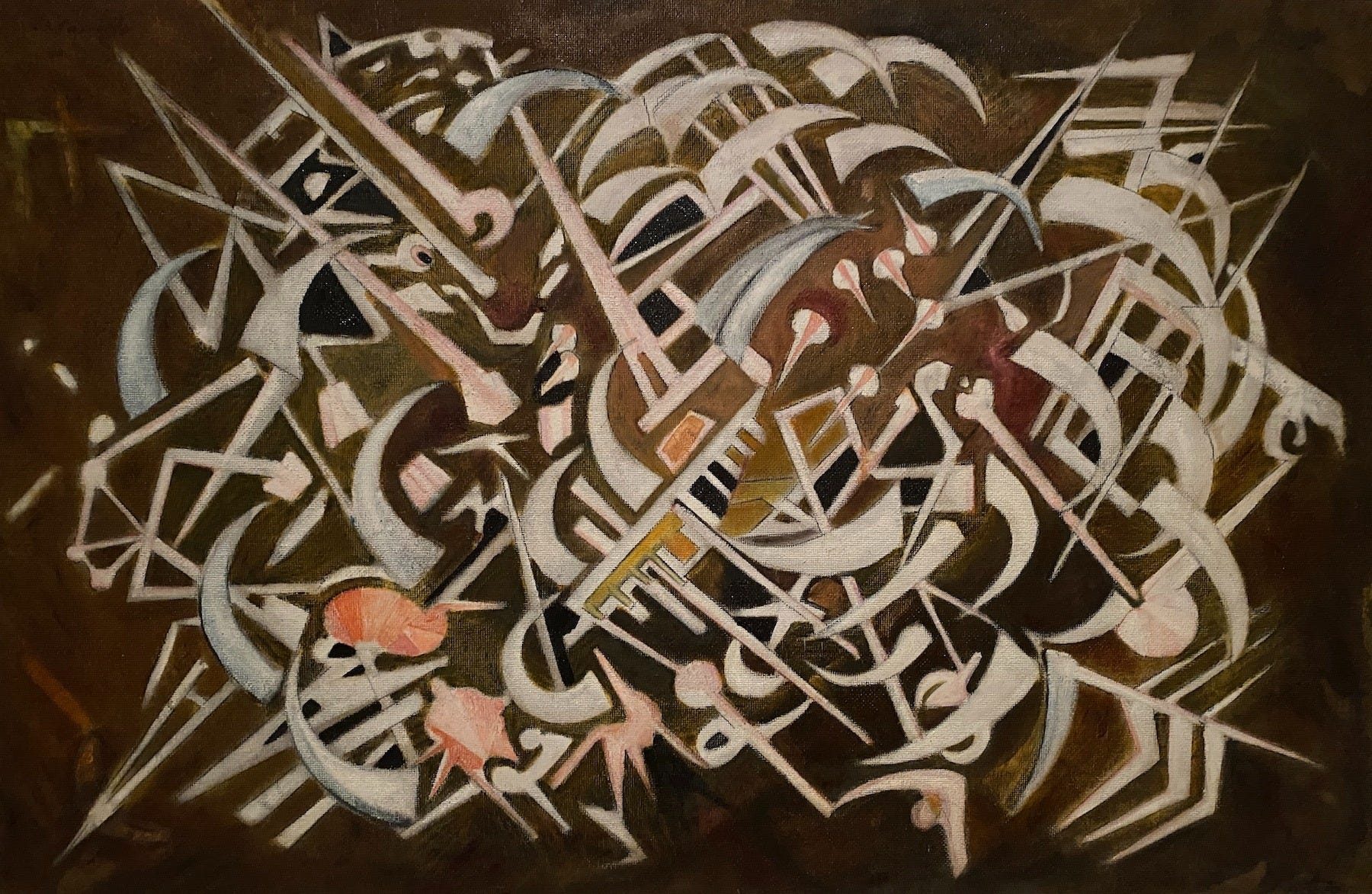
This, too, seems like it could be an alien language, or an ancient one, but it also looks like a take on Picasso’s “Guernica” from 1939. If this is how “before” the war appears, I wonder what during and after must be like. When I see Picasso I think this is retro and when I dispel Picasso and look again, I think, yeah, okay, a coming explosion of the future.
What’s confusing about this work is that there is an article he wrote in which he says a work of art is either abstract or figurative, not in-between, but the above painting is exactly in-between. That is what gives it such power. I think I must be (foolishly) misunderstanding, or else the man changed his mind. In looking him up, I discovered that there is a whole museum of his art collection in CDMX. That’ll have to be on my list for the next visit.
Sometimes art of the “future,” in someone’s opinion, is not immediately obvious as such to anyone else. This “Bas Relief” by Eduardo Chillida (1951), could be a set of symbols from outer space, but the only reason I come up with that idea is that it was in the museum’s show about the future:
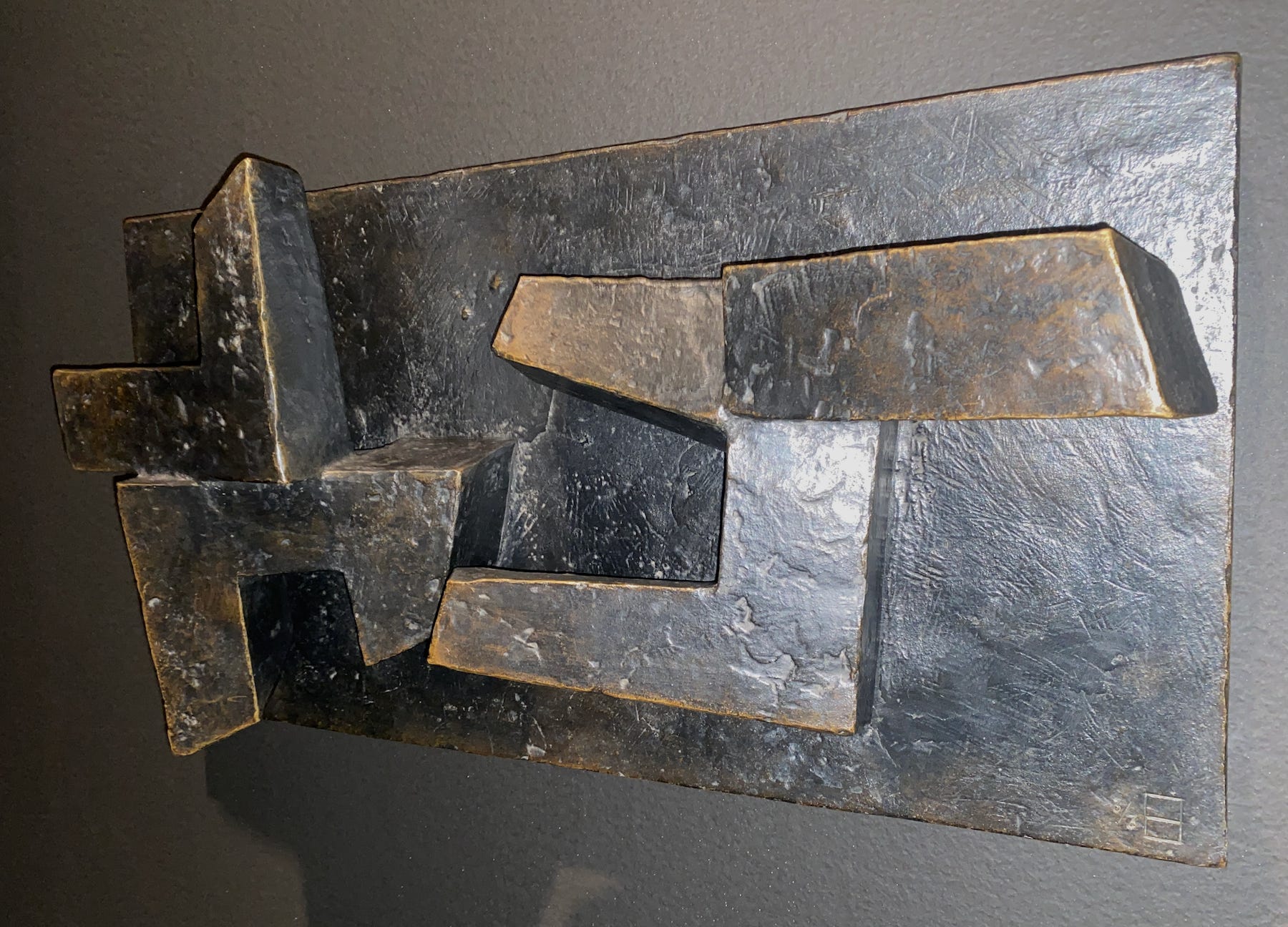
The idea that this is somehow about the future reminds me of the Star Trek episode, “The Paradise Syndrome” (1968). It, too, tells the audience that a work of modern sculpture was made by aliens from outer space:
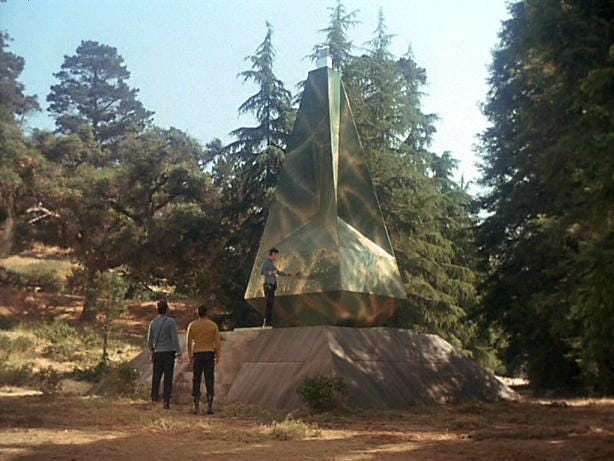
Here’s Mr. Spock trying to read the “alien” symbols:
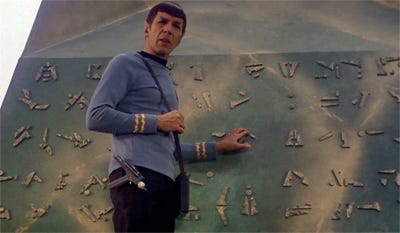
Step back, however, and the monument, which is supposed to be an asteroid laser deflector, looks like something on any American college campus, not from our future, but a solid piece of 1960s art.
For me, the best work in the show was Chilean artist Roberto Matta’s, “Homo Tumutum,” 1974. It means “A Noisy Man”:
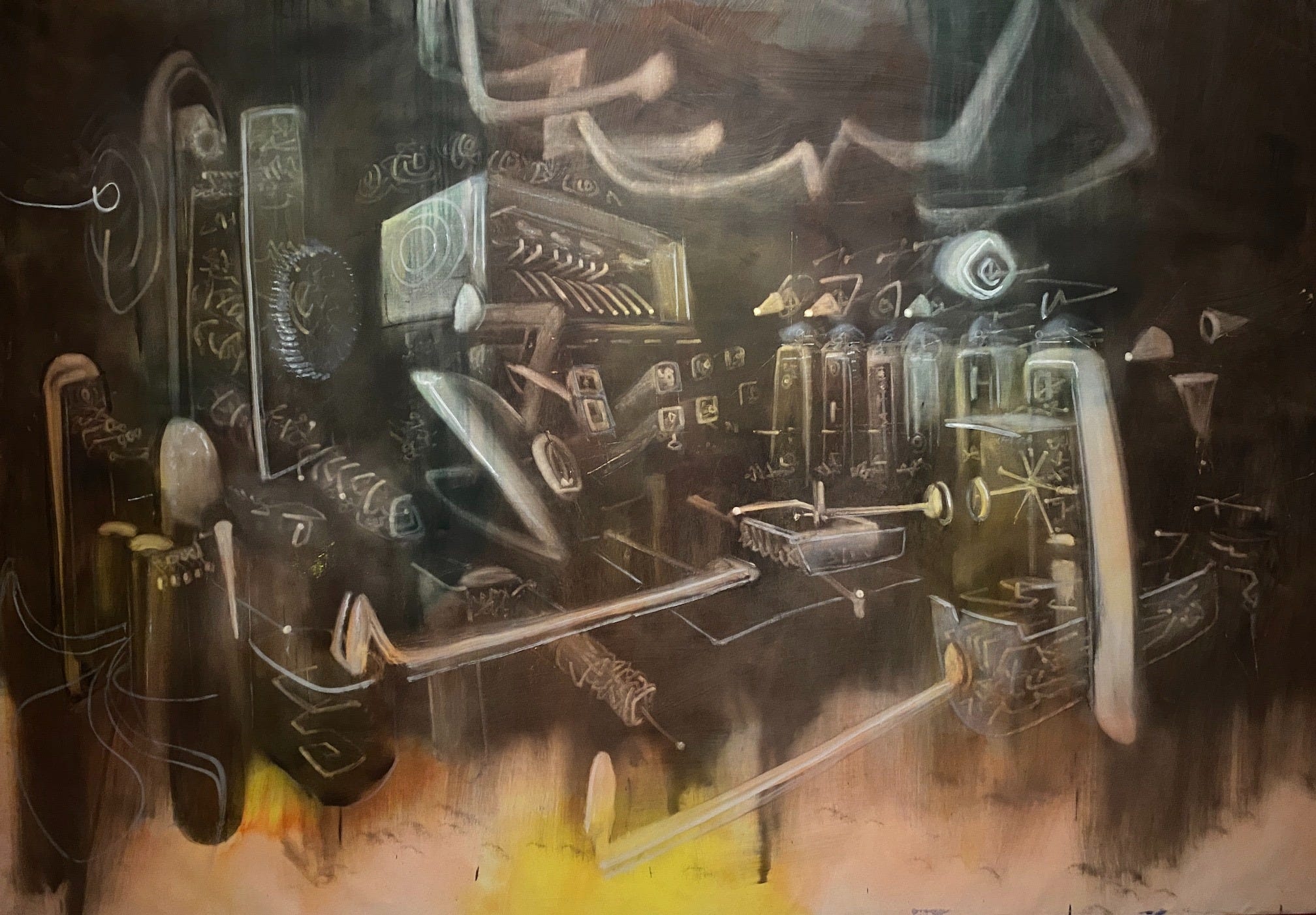
In Matta, I do see the way surrealism still has a futuristic edge, or at least a vibe of science fiction. There is a monstrous, ghostly, inexplicable and therefore frightening machine here that floats in an undefined space, doing something. Maybe the “Man” is screaming in the upper left corner, or maybe he has been dismembered and turned into the bones that float above the whole thing. The painting is typical of Matta’s in-depth half abstract landscapes, each of which leaves the viewer off-balance. However, I also see the factories that hummed through the 1970s in New York,
Matta’s futuristic hope was socialist. He was on Salvadore Allende’s side in the 1970s, cheering on the leftist political move in Chile and making a mural that stands at La Granja city hall in Santiago:
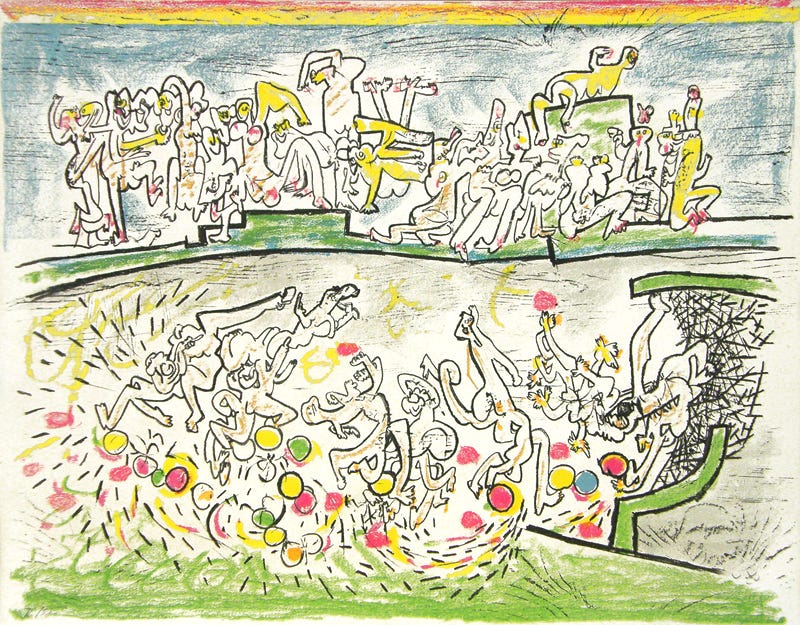
When Augusto Pinochet overthrew Allende’s legitimately elected government in 1973 (with a lot of help from Kissinger and the American C.I.A.), he had 16 coats of paint applied on top of the mural. Why? Because dictators only care about loyalty (in which case it didn’t matter what was in the mural)? Or because the mural shows naked people playing in freedom? Hard to know, as it is equally hard to know why he’d choose to cover the wall instead of destroying it and having it rebuilt. Pinochet liked to make thousands of his enemies or perceived enemies disappear. The symbolism of the coverup backfired in this mural’s case: the Chileans restored the mural in 2008 after a three-year effort. In this case as in so many others, a dictator proved incompetent, though he was good at political violence. Yeah, you know who I’m talking about.
Maybe the most interesting historical fact about the Futurist art movement that started in Italy in the early twentieth century is the way it meshed so easily with both Italian Fascism and Russian Communism. It’s easy to say now, following Orwell, that those political end points meet at the bottom of a circle, but the people inside Italian and Russian Futurist movements didn’t get along. When the inventor of Italian Futurism, Marinetti, went to Russia, the Russian Futurists shunned and blocked him. Not that this open lover of violence and hater of women was universally liked elsewhere. An interest in art about the Future was not thick enough to overcome their opposing ideologies.
My instinct is to see a focus on the future though an insufficiently skeptical admiration of technology as a feature of societies adjacent to the most tech advanced societies but not there yet themselves. Italy and Russia in the 1910s fit that description. Both Fascist and Communist political systems are attractive to people in a hurry to catch up to others. Liberal democracy with socialist values is boring in comparison. It’s like investing in a mutual index fund (“sustainable” or not) vs. Bitcoin.
The Italian Futurists can be said to have designed the style of Italian Fascism. Much of their art is so energetic that it’s impossible to dismiss for ideological reasons unless you ignore its aesthetic power. Their desire to break things and disrupt is familiar to us today. The American tech industry looks like a rightist group of people at the top (Musk, Zuckerberg) but also looks like a leftist one below that level. It’s the uprising of the tech workers during the Biden administration that led to Mark Zuckerberg and Marc Andreessen’s rightist march after they spent many years contributing to the Democrats. In other words, the people creating the future are not clearly marked with one kind of politics.
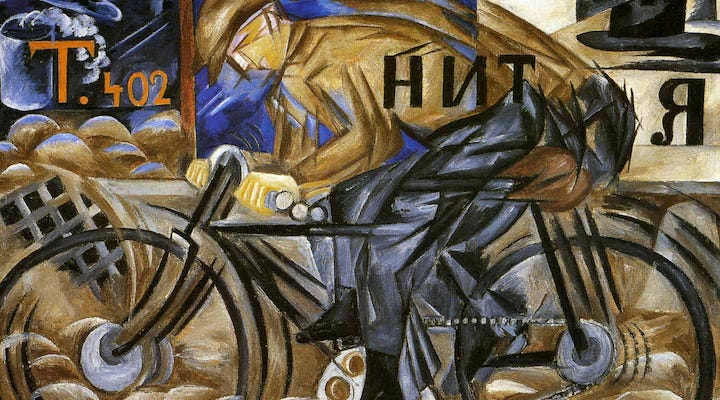
Some of the Futurists were early hippies. Natalia Goncharova shocked the Russian bourgeoisie before the Great War by painting her face for a retrospective art opening in 1913. Her embrace of new tech is not always clearly political. For example, Natalia Goncharova’s “Cyclist” (1911) celebrates modern dynamism in a way that hardly ruffles any feathers today.
Dorry Fox writes,
By 1913 Goncharova had embraced the principle of ‘everythingism’ (vsechetsvo), a term used by their colleague, the futurist poet Zdanevich, to describe her non-hierarchical openness to artistic practice. ‘We acknowledge all styles as suitable for the expression of our art, styles existing both yesterday and today — for example, cubism, futurism, orphism, and their synthesis, rayonism, for which the art of the past, like life, is an object of observation.’ She was a universal artist who, openly and without constraint, built on diverse forms of art, past and present.
“Everythingism” now sounds like a funny parody of wide-eyed hippy idealism. But the focus on the future and the idea of accepting everything are both always doomed to the realities of how little each of us knows. The irony of Futurism claiming to shed ideas of the past is that it does so using the fundamentals of old ideas of “art.” What is a painting of oil on canvas to be seen in a gallery or someone’s home? Despite what is on the canvas, there is a fundamental continuity between a Futurist painting and a painting by Leonardo da Vinci. And you can’t have “everything” in your Everythingism if you’ve not been to Africa, South America, or eastern Asia. Kudos to Goncharova for telling truth to power by showing things closer to home:
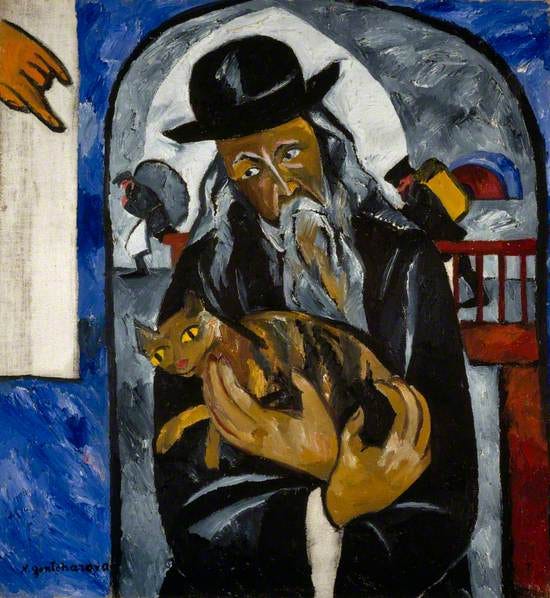
The “Rabbi with Cat” (1912) shows a person the Russian regime wanted everyone to forget in a pieta-like pose, for some reason being pointed at. Dorry writes, “This painting outraged the political and religious authorities, deliberately depicting a Jew in the format of a Russian orthodox icon that echoes the Virgin and Child.” The two background figures with sacks are Jews fleeing a pogrom?? And the hand in the corner is outing this man as the next victim? Sometimes the most transgressive thing is not to try to point to the future but merely to tell the truth about what is happening now.
Here’s what I find quite odd, futuristic, even. When I looked up this painting, it was for sale on Ebay by someone calling themself “Klenodium” for $1200. Here’s the link. Klenodium has 1793 feedbacks with a perfect score of 100% positive. I’m not qualified to say if it’s genuine but I have no reason to doubt it. He’s also selling at least one more Goncharova painting, as well as Kandinskys, Maleviches, and a bunch of other stuff.
As you say of Barbarella, "it’s more about the moment in which it is made than about the actual future." Any student of history can tell you that meditations on the future are always really about the present, whether the painter/writer/creator realizes it or not. When Orwell wrote 1984, he was slowly dying of tuberculosis. His dark tale reflected the pain of his illness and his depression at seeing his life slipping away. The sicker he got, the darker the story turned. All Orwell had to do was swap those last 2 numbers on the calendar for his title, and the literate world believed they were getting a story of the world that was to come, rather than the one he was living in right now.
Doesn't calling your work "futurism" have a presumption, and even an inherent optimism, baked into it?
I really like the Palacios and the Ianelli. Both are visually striking.